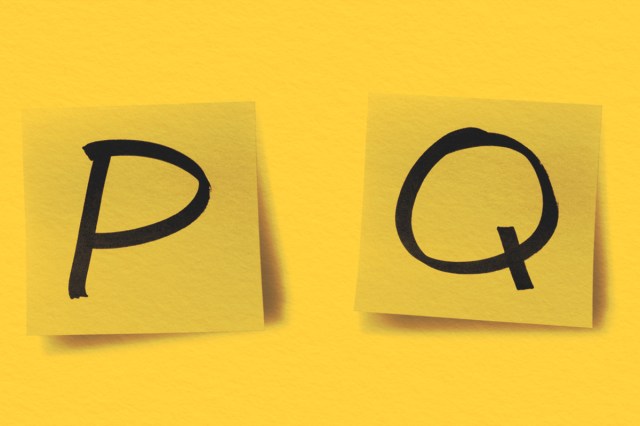
Anyone who “minds their p’s and q’s” is known for acting on their best behavior, but what do those two letters stand for? Polite and quiet? Proper and quaint? Peas and uh… qarrots? We won’t take liberties with the spelling of “carrots,” and we can further confirm that none of those options is correct. However, there are a few origin stories for this perfectly quirky turn of phrase.
Advertisement
The Oxford English Dictionary records examples of these letters in print as early as 1602, though “p’s and q’s” were sometimes written as “Pee and Kue.” “To be on one’s p’s and q’s” and variants of that phrase meant to be on one’s best behavior. The exact wording of “mind your p’s and q’s” was first documented in the 1756 book The Life & Memoirs of Ephraim Tristram Bates.
While lexicographers and dictionaries can trace the printed citations and usages of words and phrases, they often don’t reveal how these phrases originally came to be. With “p’s and q’s,” there are several possible origin stories, but none rises above the rest. It’s possibly related to the similarity of the appearance of “p” and “q” in penmanship and a warning to avoid mixing them up; a similar story is related to printers mixing up the letters when typesetting. A completely different theory is based on the idea that bartenders used to keep running tabs of the number of pints and quarts drunk by their patrons (or told the patrons to “mind their own p’s and q’s”). A fourth and final purported origin story is that “p’s and q’s” translates to “pleases and thank-yous,” as the latter part of “thank-you” sounds like the letter “Q.”
While all of these theories relate in some way to the idea of good and orderly behavior, each is dubious in its own way. We may never know the true origin of this early 17th-century phrase, so feel free to come up with a fun origin story of your own for “p’s and q’s.”
Featured image credit: photovideostock/ iStock
Advertisement
More from our network
Word Smarts is part of Inbox Studio, which publishes content that uplifts, informs, and inspires.
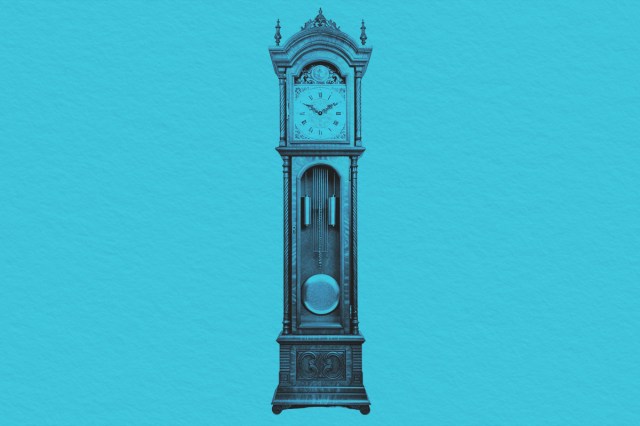
Do grandfather clocks have to be owned by grandfathers to earn the name? The clock design is much older than the name, but there’s an interesting story to go along with both.
The term “grandfather clock” has little to do with family relationships, growing older, or bowls full of Werther’s Original candy. In fact, the clock design (which the Oxford English Dictionary describes as “a weight-and-pendulum eight-day clock in a tall case”) is several generations older than the name. Let’s chime in and take a look at how this timekeeping device got its grandfatherly name.
Advertisement
Before we called it a grandfather clock, the tall-case or long-case clock was the housing for pendulum timekeeping. These types of clocks were invented in the mid-17th century by astronomer and physicist Christian Huygens. Pendulum timekeeping was vastly more accurate than spring-driven timekeeping that was otherwise available. As such, the pendulum design caught on with London clockmakers, who began producing these sleek, tall cases en masse. They were popular for their aesthetic appeal as well as their accuracy.
The name change occurred two centuries later, thanks to the popularity of the 1876 song “Grandfather’s Clock” by American composer Henry Clay Work. While visiting England, Work became fascinated by a broken long-case clock in a hotel lobby. He heard a (possibly apocryphal) story from staff that the clock belonged to the two former hotel owners and it stopped working when they both died. Inspired by this tale, Work penned song lyrics about a long-case clock that stopped working after a grandfather’s passing:
My grandfather’s clock was too large for the shelf, So it stood ninety years on the floor;
It was taller by half than the old man himself, Though it weighed not a pennyweight more.
It was bought on the morn of the day that he was born, And was always his treasure and pride;
But it stopp’d short – never to go again – When the old man died.
CHORUS
Ninety years without slumbering (tick, tick, tick, tick),
His life seconds numbering (tick, tick, tick, tick),
It stopp’d short – never to go again – When the old man died.
In watching its pendulum swing to and fro, Many hours had he spent while a boy;
And in childhood and manhood the clock seemed to know And to share both his grief and his joy.
For it struck twenty-four when he entered at the door, With a blooming and beautiful bride;
But it stopp’d short – never to go again – When the old man died.
Work’s song was so popular that it sold over a million copies of sheet music and changed the common name of the long-case clock to the “grandfather clock.” By 1883, the new term was being used by clockmakers and sellers, and was appearing regularly in print ads.
Featured image credit: Nubes Studio/ Shutterstock
Advertisement
More from our network
Word Smarts is part of Inbox Studio, which publishes content that uplifts, informs, and inspires.
When you tell someone to “get out of Dodge,” you’re referencing the Wild West (or at least a TV show about it). Learn more about this gunslinger catchphrase.
The state of Kansas has contributed much to American culture. For junk food connoisseurs, it’s the birthplace of Pizza Hut and ICEEs, and for classic movie fans, it’s a key part of one of the most famous film quotes of all time: “Toto, I’ve a feeling we’re not in Kansas anymore,” which Dorothy (Judy Garland) says upon her arrival to Munchkinland in The Wizard of Oz. But that’s not the only well-known line with roots in the Sunflower State — we also can trace “get out of Dodge” back to a Wild West town in Kansas.
Advertisement
This idiom, which the Oxford English Dictionary defines as “to leave, esp. quickly,” refers to the infamous Dodge City — a once-bustling cattle town on the outskirts of the American Wild West. Today it’s a small town that embraces its former notoriety through Wild West tourist draws, but in the late 19th century, Dodge City hosted a population of gunslingers and ne’er-do-well cowboys. Along with the outlaws, the famous lawmen Wyatt Earp and Bat Masterson roamed the streets, which contributed to the rowdy reputation of the town.
While Dodge City was established as the epitome of the Wild West town by the 1870s, it wasn’t until the mid-20th century that the idiom “get out of Dodge” gained widespread popularity. The radio and television series Gunsmoke — which aired in various forms from 1952 to 1975 — played a key role in popularizing this expression. Set in Dodge City during the 1890s, Gunsmoke starred James Arness as U.S. Marshal Matt Dillon, a lawman known for wielding his authority and telling criminals to “get out of Dodge.” The catchphrase soon entered the collective American lexicon, and examples began to pop up in print in the 1960s. In a 1965 edition of the National Observer: “Here are some of the expressions… the gang members were using… ‘Get out of Dodge.’” And in a 1989 edition of the St. Louis Post-Dispatch: “This is the Steele strategy — work for one big inning every game, invoke the 20-run rule and get the heck out of Dodge at the end of the fifth.”
This begs the question: Did anyone actually order outlaws to “get out of Dodge” in Dodge City during the 1890s? We can’t know for sure if the real peace officers who patrolled the town used the same lingo as the fictional U.S. Marshal Matt Dillon, but Wyatt Earp and the like certainly inspired the creators and writers of Gunsmoke.
Featured image credit: IanGoodPhotography/ iStock
Advertisement
More from our network
Word Smarts is part of Inbox Studio, which publishes content that uplifts, informs, and inspires.
The phrase “dog-eat-dog” could work in two contexts: First, maybe you’re giving your beloved fur baby a hot dog as a well-deserved birthday treat. But second, and more recognizably, the phrase “dog-eat-dog” is a figurative idiom.
Advertisement
The Oxford English Dictionary (OED) defines “dog-eat-dog” as “a situation in which people are willing to harm each other in order to succeed.” It comes from the Latin idiomcanis caninam non est, which translates into English as “a dog does not eat dog’s flesh.” The ancient Roman scholar Marcus Terentius Varro included the phrase in his seminal work, De Lingua Latina (On the Latin Language). In the Latin usage, the intended meaning was that even dogs have their limits and the animals wouldn’t eat a fellow dog, no matter how fierce they appear.
In 1813, “dog-eat-dog” appeared in English in a collection of political essays, but it repurposed the original Latin idiom and was used to suggest the exact opposite. The implication was that in the world of politics — and other cutthroat industries — “dogs” (people) don’t have any limits in the pursuit of unbridled success and power.
As people have continued to use the phrase, it’s become a bit mangled. Sometimes it’s heard (and written) as “doggy dog world.” While the idea of a planet full of even more dogs sounds wonderful, “doggy dog world” is an “eggcorn” — a word or phrase that’s misheard and repeated due to having similar sounds. It’s been a “dog-eat-dog world” since the days of ancient Rome.
Featured image credit: Joy Brown/ Shutterstock
Advertisement
More from our network
Word Smarts is part of Inbox Studio, which publishes content that uplifts, informs, and inspires.
The world is full of peculiar pairings that just seem to work perfectly. Take chicken and waffles — how is it that two diametrically opposed foods taste so amazing together? There are equally odd pairings in the world of linguistics, too. Consider the words “how” and “come.” At first glance, “how come” seems like an incomplete sentence, but it’s actually acceptable as is. So, how come we say “how come”? Let’s take a closer look.
Advertisement
According to the Oxford English Dictionary (OED), the phrase “how come” dates to at least 1844, with an example appearing in Ladies’ National Magazine: “‘Ha, ha, ha!’ roared Hector, ‘you larf at me, eh, fer being frighten’ at panter, tort I’d fix you fer um—I say, gal, how come you jump so? what you tort twas, eh?” To get the full understanding of that example, try reading it aloud — many of the words are spelled phonetically, likely for effect. But “how come” is clear; in the example and now, it’s mainly used in place of the word “why,” as in, “Why/how did it come about?” Grammatically, the subject and verb of “How come?” are implied, which makes it a functionally complete sentence, albeit in a very casual tone.
This begs the question: Why use “how come” instead of “why,” given that “why” is far more common and easily understood (and shorter)? The reason mainly has to do with encouraging a more relaxed and conversational tone. “Why” is blunt, and the person on the receiving end of the question may feel like they’re being lectured. Saying “how come” may invite a bit of further conversation and encourage a lighthearted dialogue.
Here’s an example: The question “Why did you call me?” could come across as very pointed and perhaps a bit angry in tone. As an alternative, “How come you called me?” is less of an inherently antagonistic question, and may make the other person feel more at ease.
Featured image credit: Jacob Wackerhausen/ iStock
Advertisement
More from our network
Word Smarts is part of Inbox Studio, which publishes content that uplifts, informs, and inspires.
What’s the Difference Between “Sardonic” and “Sarcastic”?
At first glance, “sardonic” and “sarcastic” might seem interchangeable, but they convey very different tones. Before you send the wrong message, learn about the difference in these tone-related adjectives.
What I enjoy most about classic sitcoms is their enduring sarcasm. Shows such as Seinfeld, Friends, and The Simpsons offer master classes on how this particular brand of wit works. Beyond their surface-level laughs, these shows demonstrate the nuances of sarcasm and a related form of humor, sardonicism. These terms might seem interchangeable at face value, but they are quite distinct.
Advertisement
Take, for instance, an episode of The Simpsons titled “The Fool Monty,” in which Homer reacts to the intrusive new surveillance cameras around town with a sarcastic tone. “Oh, great!” he exclaims. “The government’s watching us like in that book… 1984, the one with the Big Brother.” (Who knew Homer Simpson was such a literary scholar?) Of course, Homer doesn’t actually think the cameras are a good thing. He’s using sarcasm to convey frustration and disdain by saying the opposite of what he really means. Sarcasm is often expressed as a biting form of humor to mock or ridicule, usually accompanied by exaggerated vocal tones, eye rolls, or a wry smile. Sardonicism, however, is not as easily detected.
In contrast to the “we’re all in on the joke” tone of sarcasm, sardonicism is laced with pessimism, distrust, or bitterness. For example, in 1984 — the dystopian novel Homer mentioned — author George Orwell’s tone is sardonic. Three slogans represent the totalitarian regime known as the Party: “War Is Peace,” “Freedom Is Slavery,” and “Ignorance Is Strength.” These could be described as sarcastic, but their true essence lies in the cynical mockery of the totalitarian propaganda in Orwell’s story. The tone of the slogans is not just ironic, but also steeped in despair — it’s sardonic.
In everyday conversation, sardonic comments tend to be more subtle and require context for true understanding. For example, say your computer is malfunctioning, and IT recommends a “simple fix” that is estimated to take six hours to implement. A sardonic response might be: “I love how this is called a ‘simple fix’ — it’s so simple that it takes all day.” It expresses frustration, though such a sardonic response would likely be best kept as an inside thought. On the other hand, a sarcastic response might be: “Great! I could use a day of playing Candy Crush while you do the hard work!” The sarcastic reply here is more direct and aims for lighthearted humor, while sardonicism carries an underlying tone of frustration and resignation.
Next time you’re watching your favorite sitcom, tune in to the subtle differences between sarcastic and sardonic tones. It’s a great way to sharpen your understanding of the nuance of wordplay and discover the intent of your favorite characters.
Featured image credit: Asier Romero/ Shutterstock
Advertisement
More from our network
Word Smarts is part of Inbox Studio, which publishes content that uplifts, informs, and inspires.
The further (or is it “farther”?) we get from grade-school grammar classes, the harder it is to recall the specific rules we learned. And even when we were in class, did we really understand the nitty-gritty of all of them? English has a lot of grammar rules, but in part because they can be so tricky to decipher, they’re often broken. As language is constantly evolving, the more a rule is broken, the more those broken rules become accepted exceptions over time. Here are several word pairs that have been so often mistaken or confused that the mistakes have become recognized as standard use.
Advertisement
"Farther" vs. "Further"
These words come from the same etymological root (the Old English fyrðrian), which explains much of the confusion, but the terms have evolved to describe distance in different ways.
“Farther” specifically describes physical distance, either with an exact measure or in a general sense: “Drive 10 miles farther,” or “We need to go farther.”
“Further” also describes distance, but it concerns time, degree, and metaphorical spaces. For example: “Before we go further in our relationship, let’s discuss kids,” or “The situation has improved further in the last week,” or “I want to further myself in the department.” Consider this last metaphorical example to help you distinguish between “farther” and “further.” “Far” is a literal place in the distance you can walk or travel to. Furthering your career, meanwhile, refers to progress in a figurative sense; you can’t simply plug a destination into your GPS and arrive at a promotion.
Note: Many native English speakers use “further” as an adverb to describe a comparative distance. For example, “He lives further from the gym than his brother does.” It’s not necessarily incorrect, but some grammar sticklers disagree with it.
Advertisement
"Fewer" vs. "Less"
There’s only one adjective to signify a greater amount: “more.” But there are two adjectives that describe a lesser amount: “fewer” and “less.” It’s easy to confuse these two, because the rule around which to use is somewhat arbitrary.
“Fewer” is paired with nouns that can be counted (“fewer dogs,” “fewer houses,” “fewer books”), while “less” is used with nouns that can’t be counted (“less water,” “less rice,” and “less space”).
It seems like a simple and straightforward distinction, but looking at the etymology of the words in the Oxford English Dictionary (OED) reveals that both “less” and “few” trace back to Old English writings in the 700s CE. “Fewer” (as a comparative form of “few”) didn’t appear until 1340 — which means “less” was employed for the same usage as “fewer” for hundreds of years without any confusion. The specific rule for the distinction between “less” and “fewer” was invented in 1770 by a grammarian named Robert Baker — he suggested his rule would be “not only more elegant … but more strictly proper.”
Of course, there are less-than-elegant exceptions to the “proper” rule. For example, even though money, time, and weight can be counted, the word “less” is typically paired with these concepts (“less than three dollars,” “less than 10 minutes,” and “less than 20 pounds”).
Advertisement
"Literally" vs. "Figuratively"
“Literally” has turned into a somewhat controversial word, but its meaning has evolved over time. For example, someone might exclaim, “I literally died,” while sharing shocking news. The listener understands this is a figure of speech. In this context, the word “literally” can mean “taking words in their usual or most basic sense,” but it can also mean “figuratively” or “virtually.” In other words, don’t take someone who says, “I literally died,” literally. While it’s a common pet peeve for grammar sticklers, this usage isn’t new. It was used in metaphors and hyperboles dating back to the 17th century, and both the OED andMerriam-Webster have declared the metaphorical sense of “literally” to be acceptable usage.
Both “since” and “because” are conjunctions, but true grammar students will notice differences between the words. “Because” implies causation (“Because we’re going to the beach, I’ll bring my sunglasses”), while “since” can refer to two things linked by time (“Since she was elected mayor, her approval ratings have dropped”) or causation (“Since it’s Tuesday, we’re having tacos”).
“Because” is typically a stronger word than “since” when discussing causation, but the words can be (and are) used interchangeably. However, “since” can create ambiguity in a sentence. Consider this statement: “Since Diana went to school, she learned about science.” Did Diana learn about science as a result of attending school? Or did her science education simply start when she went to school? It’s a little unclear. However, this sentence would usually have more information around it to give it context, and the risk of confusing readers is pretty low.
Featured image credit: ChristinLola/ iStock
Advertisement
More from our network
Word Smarts is part of Inbox Studio, which publishes content that uplifts, informs, and inspires.
Who is “Jack” and what does he have to do with trades? Going back to the 16th century, there was a specific person the original phrase referred to, and you’ll recognize the name.
Are you the type of person who knows how to change a car’s oil, cook the perfect steak, speak four languages, build a house from scratch, and paint an absolute masterpiece? If so, then one of two things is true: Either you’re lying, or you’re a Jack of all trades. The latter is a phrase that refers to someone who’s very good at many things. It’s an impressive feat to become a Jack (or Jill) of all trades, but the familiar expression is easier to explain.
Advertisement
One of the earliest theories comes from a 1592 pamphlet that makes a reference to Shakespeare, who was just beginning to make a name for himself at the time. The Latin phrase “Iohannes fac totum” loosely translates in Elizabethan English to “Johnny-do-it-all.” Some Shakespeare scholars think, given the contextual clues found in the pamphlet the author was referencing William Shakepseare, who was just beginning his prolific playwriting career at that time. This “Johnny-do-it-all” would have been an earlier version of “Jack of all trades.”
The actual phrasing showed up a few decades later. In 1618’s Essays and Characters of a Prison and Prisoners, Geffray Mynshul wrote: “Some broken Cittizen, who hath plaid Iack of all trades. The letter “j” was the last letter added to the alphabet, so the “i” often replaced the “j” in early printed works. ” However, by the mid-17th century, “j” was solidified in the alphabet, and “Jack of all trades” was being used to describe anyone who was adept in a wide variety of fields.
In the 18th century, extra meaning was added as the phrase was expanded to “Jack of all trades and master of none.” While you could still simply refer to someone as a “Jack of all trades” on its own, adding “master of none” meant you were ridiculing them for failing to excel. Today, the phrase can be used in its original complimentary form, or as the more recently coined insult.
Featured image credit: Nosyrevy/ iStock
Advertisement
More from our network
Word Smarts is part of Inbox Studio, which publishes content that uplifts, informs, and inspires.
Why Do We Say ‘Easy as Pie’ When Baking Isn’t Easy?
If you’ve experienced soggy bottoms and burned crusts, you know baking a pie isn’t easy — so where did this phrase come from? The answer is easy as … you know.
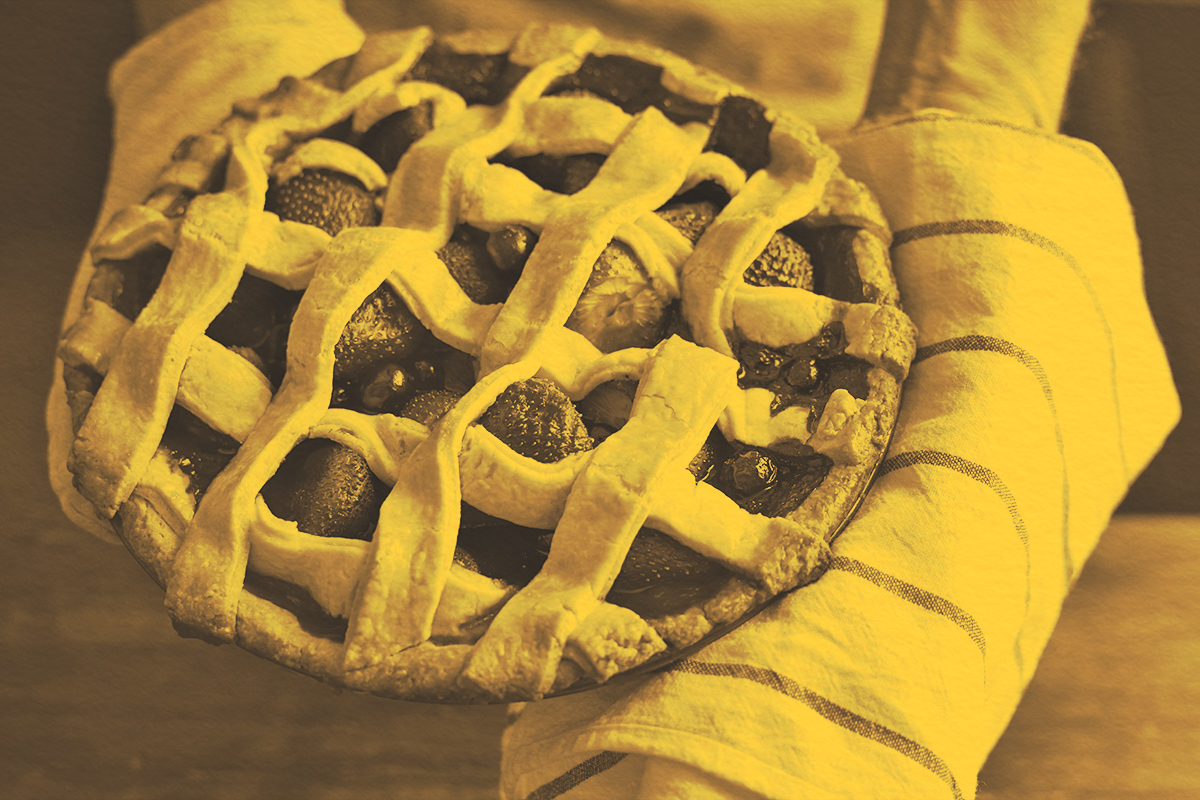
If you’ve ever tried crafting a perfectly flaky pie crust, you’ll likely agree that the phrase “easy as pie” has little in common with the intricacies of baking. So why has pie been a go-to metaphor for all things effortless for the last hundred years? The answer lies in eating the pie, not baking it.
Advertisement
The phrase “easy as pie” popped up as U.S. slang in the last years of the 1800s, but a slightly earlier version of the expression — “like eating pie” — debuted in the horse-racing newspaperSporting Life in 1886. This earlier expression establishes the key link between pie and simplicity: While baking a pie can be challenging, eating one is undeniably simple. This ease of enjoyment likely led to “easy as pie” earning its spot in the English lexicon.
The history of pies offers more insight. In medieval times, pies offered convenience: They kept meat fresh during long voyages and served as a main course at large banquets. Unlike today’s elaborately decorative pie crusts, these pies had utilitarian designs, which made them easy to transport.
The idea of a familiar food being easy or simple is shared in other metaphors. Consider the expression “a piece of cake.” This phrase didn’t come about until the 20th century, as seen in The Primrose Path, a 1936 book of poems by Ogden Nash: “Her picture’s in the papers now, and life’s a piece of cake.” These lines imply that life, like cake, can be simple and sweet. The metaphor exists in other languages, too. The Spanish phrase “Ser pan comido” translates literally as “to be eaten bread,” but it has the idiomatic meaning of “be a piece of cake.” In Swedish, the equivalent is the expression “Lätt som en plätt” (“easy as a pancake”).
The origins of these pastry and baking metaphors are part of a larger tradition of using universal concepts to create memorable and fun expressions, adding a little flavor to everyday conversation.
Featured image credit: Rawpixel/ Shutterstock
Advertisement
More from our network
Word Smarts is part of Inbox Studio, which publishes content that uplifts, informs, and inspires.
The legacy of the ancient Romans is impossible to deny, as they gave us so much that we continue to rely upon today: bridges, roads and even toga parties. The Romans are also whom we can thank for naming every month of the year, as we still use their names over 2,000 years later. Let’s start with January, the very first month of the year. January is named after Janus, the Roman god of new beginnings, whose own name is based on the Latin word for “doorway.” This is quite appropriate considering that so many folks use the new year as a time to open the door on a new chapter in life.
Advertisement
Now let’s look at the second month of the year. At first glance, you may assume that February was also named after a god — specifically Februus, the ancient Roman god of purifications. However, it’s not that simple. Both the month and the god were actually named after Februa, a purification festival that occurred around that time of year. This festival took its name from the Latin word februum, meaning “purification.”
Both of the terms “January” — Ianuarius in Latin — and “February” (Februarius) were purportedly coined around 713 BCE by Numa Pompilius, the second King of Rome. In that year, he added both months to the ancient Roman calendar, which was previously only 10 months long and began in March. No later than 153 BCE, the Romans moved the new year up from the Ides of March (March 15) to January 1. Later in the year 45 BCE, the Romans formally adopted the new Julian Calendar, named after Julius Caesar, which formally established January and February as the first two months of the year.
Featured image credit: Amanda Alamsyah/ Shutterstock
Advertisement
More from our network
Word Smarts is part of Inbox Studio, which publishes content that uplifts, informs, and inspires.
Enter your email to receive daily lessons that dive into what makes English so fascinating. Each email is packed with odd rules, etymologies, and the tools you need to be a better communicator.
Sorry, your email address is not valid. Please try again.
Sorry, your email address is not valid. Please try again.