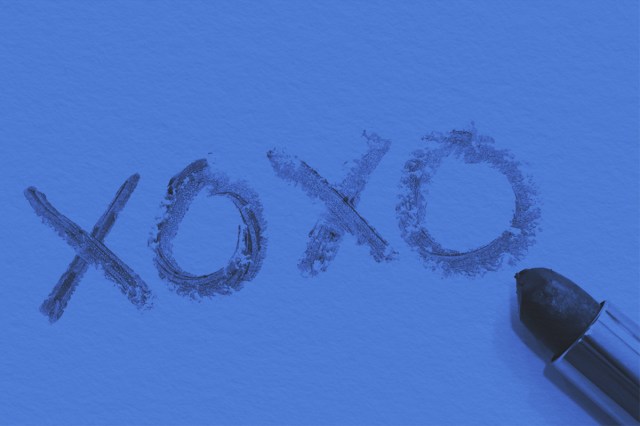
If you’re sending a Valentine, do you know what you’re saying with your X’s and O’s? These letters likely developed out of a far-from-romantic origin story.
Nothing beats giving a big bear hug and a sloppy smooch to your sweetheart, but if you’re facing a long-distance romance, it’s more challenging to convey your affection. Ending a love letter with “XOXO” means “kisses and hugs,” but you might be wondering why we use those letters, instead of “KHKH.”
Before the “X” stood for kisses, it was a representation of identity. In medieval times, much of the population couldn’t read or write their name. If someone couldn’t sign their name, it was common to sign important documents with an “X” or a similarly shaped cross symbol. The majority of English speakers were devout Christians who believed that “X” represented the sign of the cross and Christ. Signing a document with “X” implied a sense of sincerity and fidelity.
How “X” came to develop an explicitly romantic connotation is less clear, though there are many theories. Marcel Danesi — author of The History of the Kiss!— suggests that the transition may have been an act of secular rebellion among those who used it to say, “You can’t tell me who I should marry.” Researcher Stephen Goranson suggests that it’s simpler, and that the “X” likely meant “blessings,” which in time evolved to “kiss.” It also may have to do with the letter’s shape, as some think “X” looks like puckered lips.
There are even fewer concrete ties linking “O” to “hugs,” though we can elaborate a little. Dictionary.com suggests a possibility that the first people to use “O” in contrast to “X” may have been illiterate Jewish immigrants to the United States, who signed documents with an “O” to differentiate from the Christian “X.” So while “X” evolved to mean “kiss,” “O” might have evolved in tandem to mean “hug,” given that aforementioned connection. Another theory relates to the shape of the letter, as “O” looks like a pair of encircled arms.
While there’s no 100% verified backstory, using “XOXO” as an affectionate message meaning “kisses and hugs” became popular by the 1960s. It’s mainly an Americanism, as over in England you’re far more likely to see “XX, or double kisses, as a romantic sign-off.
Featured image credit: daphne.t/ Shutterstock
Advertisement
More from our network
Word Smarts is part of Inbox Studio, which publishes content that uplifts, informs, and inspires.
Life in the Middle Ages was far from glamorous. For instance, it was common for a medieval England household to share the home with livestock, and leeches were a regular medical treatment. Humble holiday feasts often featured a main course of pheasant, which was hunted, not purchased at a grocery store like a Thanksgiving turkey is today. It’s from the hunting traditions of medieval England that we get one of the most enduring English idioms for linguistic evasion: “beating around the bush.”
You might have used this expression as a colorful way to tell someone to stop dodging the central issue. For example, if a co-worker offers only insignificant details about a meeting, you might say, “Quit beating around the bush! Tell me what they decided.” The phrase implies stalling or deliberately avoiding something, whether out of reluctance, fear, or even excitement.
Now a mainstay in modern metaphor, this idiom once referred to a literal activity in 15th-century England. Hunters would carefully “beat” bushes with long sticks, coaxing small animals out of hiding without frightening them. It required a delicate balance because harshly thrashing the bushes would send the game scattering, but gently agitating the perimeter would drive the animals into nets or traps. The practice of “beating the bushes” was integral to medieval hunting and trapping.
Over time, the phrase naturally transformed into a metaphorical expression for conversational evasion. Just as medieval hunters once skirted around bushes with sticks, modern raconteurs now dodge direct answers — sometimes receiving a playful nudge to “get to the point” from this idiom.
Featured image credit: ArtistGNDphotography/ iStock
Advertisement
More from our network
Word Smarts is part of Inbox Studio, which publishes content that uplifts, informs, and inspires.
Whether scrawled on ancient papyrus or composed in a quick text message, love letters have remained powerful expressions of affection and devotion across the centuries.
Handwritten letters are a long-cherished way to express one of the most profound human emotions: love. As seen in the hurried scribbles of soldiers on the front lines or the turmoil of unrequited love, these letters capture the essence of a universal language. While today’s romantic exchanges might take the form of acronyms and emojis, the sentiment remains the same, hearkening back to the very first love letters, crafted thousands of years ago.
The Earliest Love Letters
Today, everyone is just a few clicks away, but communication throughout history has been much more complicated. For centuries, letters were the only way to bridge distances, and as such, people fell in and out of love through these lines.
The history of love letters traces back to the Bhagavata-purana, a 10th-century sacred Hindu text. In one story, Princess Rukmini writes a love letter to Lord Krishna, proclaiming her unwavering affection. Declarations of love through writing were common in other ancient empires, too. In Egypt, love songs from the Ramesside period (13th to 12th centuries BCE) survive on rolls of papyrus, chronicling firsthand accounts of the trials and tribulations of love.
In ancient Rome, Cicero, one of the empire’s most prolific writers, put his pen to love letters. To his third wife, Calpurnia, he wrote:
“Yet this only makes me feel your absence the more keenly, for if your letters have such a charm for me, you can imagine how sweet I find your conversation. However, do not fail to write as often as you can, even though your letters torture as well as delight me. Farewell.”
Famous Declarations of Adoration
Tales of romance are among the most enduring in history, proving that even the most powerful and famous individuals are not immune to the vulnerability of love. Take, for instance, Napoleon Bonaparte, the military leader who conquered much of Europe in the late 18th and early 19th centuries. Historians estimate that Napoleon wrote over 250 love letters to his wife Joséphine. These letters convey not only his affection but also his grandiose nature. In March 1796, he wrote: “I thought that I loved you months ago, but since my separation from you I feel that I love you a thousand fold more. Each day since I knew you, have I adored you yet more and more.”
Though better known for composing symphonies and sonatas, Beethoven poured his heart into a letter to the so-called “Immortal Beloved.” The recipient’s true identity remains a mystery, but the letter, which Beethoven kept with him until his death, is proof of a romance that likely never came to fruition. A famous excerpt from the 1812 letter reads: “Though still in bed, my thoughts go out to you, my Immortal Beloved, Be calm–love me–today–yesterday–what tearful longings for you–you–you–my life–my all–farewell. Oh continue to love me–never misjudge the most faithful heart of your beloved.” He signed off with the words “Ever thine. Ever mine. Ever ours.”
Years later, the literary love affair of authors Virginia Woolf and Vita Sackville-West produced some of the most beautifully written letters of the 20th century. Despite hiding their romance under the guise of friendship, the women’s correspondence reveals a deep emotional connection. In 1927, Vita wrote, “I am reduced to a thing that wants Virginia. I composed a beautiful letter to you in the sleepless nightmare hours of the night, and it has all gone: I just miss you, in a quite simple desperate human way.”
Advertisement
New Traditions Emerge
Victorian-era love letters were essential to courtship in America and Great Britain, and etiquette manuals provided advice on crafting the perfect letter. It needed to be as eloquent as it was appropriate — one couldn’t be too forward. In a time when courting couples were not permitted private meetings until marriage, exchanging love letters was perceived as an intimate act, akin to holding a hand or sharing a kiss.
This tradition found new prominence during World War I, when young couples relied on love letters to maintain relationships as they were separated by thousands of miles and the experience of war. The romantic tradition persisted during World War II, as demonstrated by President George H. W. Bush’s 1943 letter to his then-fiancée, Barbara:
“This should be a very easy letter to write — words should come easily and in short it should be simple for me to tell you how desperately happy I was to open the paper and see the announcement of our engagement, but somehow I can’t possibly say all in a letter I should like to.”
Today’s love letters undoubtedly sound worlds apart from their predecessors — one look at their salutations provides evidence. Translating an early Middle Ages letter into modern English gives us: “To my sweetest and dearest in everything, my honey-sweet girlfriend [insert name here]…” Today, a succinct “Hey, babe” via text message is far more likely.
It seems that over-the-top written expressions of affection have disappeared in the face of social media feeds and online status updates. Flowery prose has been sacrificed to keep up with our fast-paced lives. But just because the pomp and circumstance of pen and paper have faded doesn’t mean modern love letters have to lack intention. Instead of graceful penmanship, consider your carefully selected heart emojis. The human desire to connect is timeless, and digital communication can say just as much as parchment letters that have crossed the ocean.
Featured image credit: Annie Spratt/ Unsplash
Advertisement
More from our network
Word Smarts is part of Inbox Studio, which publishes content that uplifts, informs, and inspires.
Although they’re historically frowned upon, the rule against split infinitives is more guideline than law. In some cases, split infinitives can enhance meaning and tone.
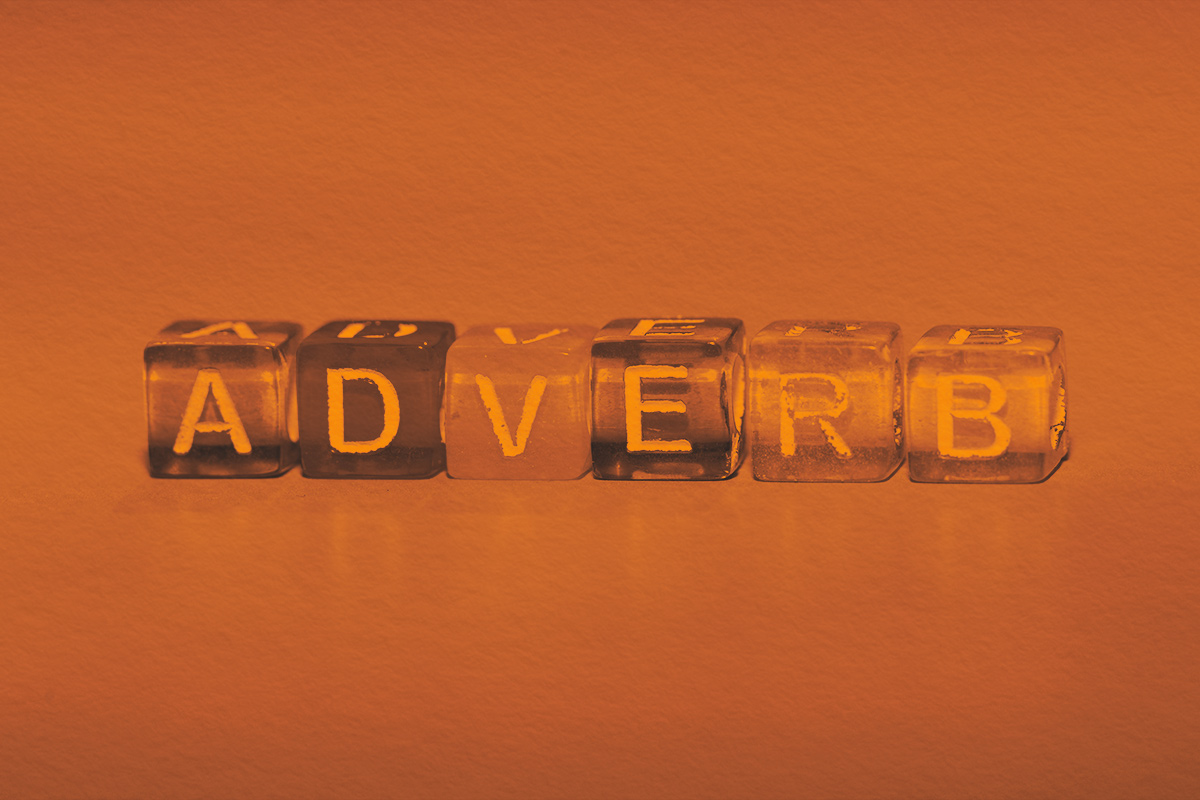
Consider the classic mission statement from Star Trek‘s USS Enterprise: “To boldly go where no man has gone before.” Captain Kirk’s split infinitive — placing the adverb “boldly” between the parts of the infinitive “to” and “go” — gives the phrase a sense of urgency and drama that would be lost in an “unsplit” version: “To go boldly where no man has gone before.” This often-quoted example shows that split infinitives have a purpose, even when traditional grammar purists may argue against them.
An infinitive is the form of a verb created by adding “to” to the base form of a verb, such as “to go” or “to speak.” A split infinitive is created when an adverb is inserted between “to” and the principal verb, as in “to secretly admire” or “to carefully examine.” Splitting an infinitive can indeed cause ambiguity or confusion in a sentence, but it is not inherently incorrect and, in fact, can sometimes improve the sentence’s tone or meaning.
Advertisement
In some cases, for example, splitting the infinitive can highlight a specific action. Consider: “My manager has to regularly analyze updated prices.” Here, the manager’s action of analyzing prices on a regular cadence is the focus. However, “unsplitting” the infinitive changes the meaning: “My manager has to analyze regularly updated prices.” Now, it’s unclear if the manager is analyzing on a regular schedule or if the prices are updated regularly. Split infinitives can reduce ambiguity. It’s worth noting that you can “unsplit” the same sentence as “My manager regularly has to analyze updated prices,” and the meaning is clear. It really comes down to the flow of the sentence and where you want the emphasis to land.
There are, however, occasions when splitting should be avoided, particularly in formal or academic writing where some style guides discourage it. It’s also best to forgo split infinitives if a sentence contains multiple adverbs: “Be sure to speak slowly, confidently, and clearly” is more explicit than “Be sure to slowly, confidently, and clearly speak.”
Ultimately, the rule against split infinitives is outdated, and there’s no rigid grammar law against it. May this empower you to boldly go where no writer has gone before and split your infinitives when necessary.
Featured image credit: BongkarnGraphic/ Shutterstock
Advertisement
More from our network
Word Smarts is part of Inbox Studio, which publishes content that uplifts, informs, and inspires.
When trying to express yourself, you may struggle to come up with the perfect word. It could be a case of lethologica (the technical word for a word being on the tip of your tongue), but sometimes, the right word simply doesn’t exist. The good news is the English language is always evolving, and our collective lexicon has plenty of room for newly coined terms. Some come from pop culture — think “rejoicify” from Wicked or “embiggen” from The Simpsons — while others are concocted by regular people like you and me.
We asked Optimism team members to answer one question: What word do you think should exist? Responses came in with definitions, explanations, and etymological breakdowns. Here are a few words our team would like to see added to the dictionary.
Somniful
Do you know that satisfying feeling of slipping into a cozy, well-made bed after a long, productive day? We think the perfect word to describe that state would be “somniful,” derived from the Latin prefix somni-, meaning “sleep.” This suggestion comes from Brooke Robinson, Associate Editor of Interesting Facts. She says it describes how she feels as she climbs into bed when the house is clean and she’s freshly showered and ready to be lulled into a deep, restful slumber.
Relaxxiety
Have you ever felt like you can’t relax and should be out in the world trying to accomplish something? This unsettling feeling could be called “relaxxiety” — a mix of the words “relax” and “anxiety.” Chief Brand Officer Mike Newman suggests it to describe some of the anxieties that many of us often feel. Another anxiety-related proposal is the term “nightxiety” — perfect for when you can’t fall asleep because you’re too stressed about being awake at an ungodly hour.
Advertisement
Bibliothekpanik
Sometimes loanwords from other languages make their way into the English language, so we felt it was appropriate to create our own. We turn to German influences to create“bibliothekpanik,” which can be defined as panicking over the sheer number of unread books you see when entering a library. This idea comes from Jennifer Freeman, who’s both a voracious reader and also the editor of Word Smarts. As someone who wants to read more books than there’s time for, Freeman experiences the specific angst of bibliothekpanik often, and suggests a few additional (faux) synonyms: “büchersehnsuchtangst” (taken from the German words for “books,” “deep yearning,” and “angst”) and “leseschuldangst,” which breaks down into “reading,” “guilt” and “fear.”
Regrot
“Regrot” combines “regret” and “forgotten,” such as when you reminisce about cringy things you did years ago. Nobody likes experiencing regrot, including our Senior Managing Editor Allie Takeda, who came up with the concept. Unfortunately, we all endure regrot from time to time, no matter how much we’d like to forget our embarrassing high school memories.
This suggestion comes from yours truly, a person who would sooner arrive 30 minutes early than risk being five minutes late. “Precrastinate” combines the prefix “pre-,” meaning “before,” and “procrastinate,” which describes the act of putting something off. But if you’re a precrastinator like me, you’re perfectly content to sit in silence for an hour before an event, as long as you won’t miss a moment. In my opinion, it’s better to be early than to wait in long lines and risk getting in after the event has started.
These are just a few of the fun terms that our team came up with, but the sky is the limit. Send us your suggestions for words that you’d like to see added to the dictionary.
Featured image credit: busracavus/ iStock
Advertisement
More from our network
Word Smarts is part of Inbox Studio, which publishes content that uplifts, informs, and inspires.
When faced with something immense, sometimes the simplest reaction is letting your jaw drop in stunned silence. But if you’re looking for words to describe what you’re seeing, common vocabulary is either “large” or “big.” These synonyms are effectively interchangeable for physical size or a huge number, but there are nuanced differences between the words to describe less tangible qualities than sheer mass.
In general, think of “large” as a more quantifiable term that describes immensity, and think of “big” as a colloquial, flexible word that conveys feelings of importance. For example, “a big birthday party” could mean either an important birthday or one attended by many people. But “a large birthday party” doesn’t have the same connotation of importance. Instead, “large” would be used to describe measurable amounts, such as the actual attendance numbers or size of the event space.
Consider the way we call someone “the bigger person” for how they admirably handle a tough situation. You’re not commenting on their physical size; it’s a statement of their emotional greatness. “Large,” on the other hand, is the correct choice in many professional contexts, such as discussing “a large customer base.” This is especially appropriate when there’s a comparison to smaller or larger sizes.
While “big” and “large” are synonymous in many contexts, understanding these nuances can help kick your communication and writing up a notch. Is it a big deal if you get it wrong? Only if a large number of people misunderstand you.
Featured image credit: Roman Samborskyi/ Shutterstock
Advertisement
More from our network
Word Smarts is part of Inbox Studio, which publishes content that uplifts, informs, and inspires.
Despite the thumb being the shortest digit, there’s a long list of thumb-based idioms found in the English language. Someone may have a “green thumb,” be “under your thumb,” or even “stick out like a sore thumb.” There’s also the “rule of thumb,” a phrase that some mistakenly attribute to an 18th-century English law dictating the bounds of spousal abuse. While it is true that many popular terms and slang phrases have uncomfortable origins, we’re happy to be able to refute this theory. In reality, the origins of this idiom date back roughly a hundred years earlier than the purported law.
Advertisement
Even before the “rule of thumb” phrasing came about, the thumb was used for a unit of measure as early as the 15th century. This unit would have been roughly equivalent to the inch we use today, and at that time, it was a convenient tool everyone had handy (bad pun intended). A hand was also a unit of measure, but “foot” seems to be the only measurement term from this time period we still use.
The idiom “rule of thumb” essentially refers to any method derived from personal experience rather than one based in precise science or calculation. The Oxford English Dictionary notes an early reference appears circa 1685 in Heaven Upon Earth, a book written by Scottish preacher James Durham: “Many profest Christians are like to foolish builders, who build by guess, and by rule of thumb.”
As Durham implied, performing duties by rule of thumb may rely on guesswork, but it can also involve finely honed instinct or common sense. One example could be a carpenter who has been building houses for so long, they eyeball things instead of precisely measuring. Or perhaps a chef who doesn’t use a meat thermometer, and estimates when a steak is perfectly medium-rare by touch. Both of these situations forgo scientific tools that are readily available — instead, the person in question uses some sort of “rule of thumb” based on personal experience. The carpenter might base a cabinet installation on their knowledge of how far apart studs are usually placed, and the chef might judge the feel of a steak in the pan.
While these examples demonstrate where a rule of thumb might be used to replace more specific measurements, the phrase is also used for generally accepted knowledge. For example, “As a rule of thumb, plan to stop for gas every few hours; that will add time to your overall road trip.” This isn’t a specific measurement, but it’s giving advice or knowledge based on experience.
All told, consider “rule of thumb” to be a rough approximation more than anything. It may work out in the end, but we’d still recommend using scientific tools to confirm when something important is at stake.
Featured image credit: Curated Lifestyle/ Unsplash+
Advertisement
More from our network
Word Smarts is part of Inbox Studio, which publishes content that uplifts, informs, and inspires.
Why Does ‘Football’ Mean Something Different in the U.S.?
Football takes over America for much of the fall and winter, but to the Brits, the word means an entirely different sport. Why and when did these meanings diverge?
To the majority of the 5 billion worldwide fans of the sport Americans call “soccer,” the game is called “football.” Despite “soccer” being used almost exclusively in the United States today, we can trace the origins of the word back to distinctly British roots.
Advertisement
The Oxford English Dictionary points out that various spellings of the term “football” have been used since the early 15th century to describe any game in which balls are kicked and/or sometimes handled. In 1863, a governing body called the Football Association was formed in England to oversee organized association football (referring to the game Americans call soccer). Eight years later, the Rugby Football Union was created as the governing body for that specific game. These two organizations showed that “football” could describe multiple sports so long as they involved a ball being kicked in some way.
Around the same time in America, association football and rugby football became popular among young men on college campuses. Around the late 19th century, a new game was created using elements from both of these English games. It was dubbed gridiron football — “gridiron” referring to the field on which it was played. This sport quickly surpassed both association and rugby football in terms of popularity in the United States. People would usually skip over “gridiron,” however, and shorten the name to “football” when discussing the game for ease of conversation. This sport developed into the current form of football played by organizations such as the NFL.
So where did “soccer” come from? Interestingly enough, though it’s primarily used as an Americanism now, “soccer” was coined in England as a shortened version of “assoccer,” which itself is a shortened form of “association football.” (Oxford students reportedly created this nickname to distinguish the sport from “ruggers,” or rugby.) While Brits rarely used this nickname, it became popular here in the United States among association football players. In 1945, the U.S. Football Association officially changed its name to the U.S. Soccer Football Association as a way to differentiate soccer from football, eventually dropping “football” from the name in 1974.
Featured image credit: anton5146/ iStock
Advertisement
More from our network
Word Smarts is part of Inbox Studio, which publishes content that uplifts, informs, and inspires.
Idioms frequently capture the drama and anticipation of love, but perhaps none as aptly as “pop the question” — a charming phrase to describe the gesture of a marriage proposal.
Love has long been a muse for metaphor. Authors, poets, and songwriters have crafted countless expressions to describe the enchantment of romance, from Elvis Presley’s “Burning Love” to Washington Irving’s poetic comparison of love to “the rosy cloud in the morning of life.” Yet, before any two hearts can tie the proverbial knot, one pivotal question must be asked, or better yet, “popped.”
Advertisement
The idiom “pop the question” is a playful way to describe the act of proposing marriage. It’s deeply ingrained in modern romance culture, featuring in rom-coms and sitcoms, jewelry ads and casual conversation. And while this widespread phrase might seem like a modern invention that has become woven into everyday English, it’s been in use for centuries.
According to the Oxford English Dictionary, an early recorded use of “pop the question” dates to 1573, in A Hundreth Sundrie Flowres, the first published work of English poet George Gascoigne: “At the last Pergo popped this question vnto him.” In Gascoigne’s time, “popping the question” wasn’t strictly reserved for marriage proposals. More commonly, it meant to ask a question abruptly or unexpectedly; “pop” was metaphorical, much like the shock of a banging door or the pop of a popcorn kernel.
By the 18th century, the phrase had taken on a romantic meaning,as evidenced in the New England Courant, one of Boston’s earliest newspapers: “I should be very glad to know your Sentiments whether it would be improper for the Lady to pop the Question first.” By the mid-19th century, other uses had faded, and the phrase almost exclusively referred to a proposal.
The idiom’s enduring popularity makes perfect sense: Marriage proposals are marked by a buildup of anticipation, suspense, and, often, surprise. Much like the celebratory pop of a champagne cork, this phrase marks a pivotal moment that can take us by surprise in the best way possible.
Featured image credit: Andrew Angelov/ Shutterstock
Advertisement
More from our network
Word Smarts is part of Inbox Studio, which publishes content that uplifts, informs, and inspires.
Calling someone or something a “flash in the pan” is a lot like when parents say, “I’m not mad, I’m just disappointed.” People use this idiom in reference to anything that initially shows great promise, only to fall flat in the end. For instance, it can be used to describe a band whose second album is a disappointment compared to its first, or an exciting business idea that fails to produce a quality product.
Advertisement
But before it developed an idiomatic meaning, “flash in the pan” had a literal usage that referred to the way old firearms operated — specifically the flintlock musket. This 16th-century gun featured a little pan that contained the gunpowder. But these guns were unreliable, and it was common for the weapon to fire without discharging any ammunition. In the case of such a misfire, the gunpowder would still ignite — and that was known as a flash in the pan.
It wasn’t until the early 1800s that this phrase was used more figuratively. The Oxford English Dictionary points to an example from 1809, found in an English translation of a French novel titled Adventures of Gil Blas:“I was not remiss in composing a fine compliment..with which I meant to launch out on her part; but it was just so much flash in the pan.” Concurrently, literal uses of the phrase became less common as archaic muskets were replaced with more modern firearms that lacked the gunpowder pan.
One of the most oft-repeated rumors about this phrase is that the “flash” is related to panning for gold during the gold rush of the mid-19th century. But the musket origin story is more likely to be true, given the much earlier usage of the phrase — though that’s not to say it wasn’t repeated among prospectors.
Featured image credit: Cat Box/ Shutterstock
Advertisement
More from our network
Word Smarts is part of Inbox Studio, which publishes content that uplifts, informs, and inspires.
Enter your email to receive daily lessons that dive into what makes English so fascinating. Each email is packed with odd rules, etymologies, and the tools you need to be a better communicator.
Sorry, your email address is not valid. Please try again.
Sorry, your email address is not valid. Please try again.