Are we splitting the bill between us? Or among us? Choosing when to use “among” or “between” can be tricky, but there are a few simple rules to guide you.
Tom Petty sang, “You belong among the wildflowers,” not “You belong between the wildflowers.” And in addition to being poetry, these song lyrics illustrate an important grammatical distinction. “Between” and “among” have similar meanings, but the words are not interchangeable. The main difference is quantity. “Between” usually refers to two distinct items, while “among” is used with more than two items or an indefinite group. For example:
The shortest distance between two points is a straight line.
There is no honor among thieves.
In general, you should use “between” any time two people are involved, and when expressing a range of numbers (as in, “between 3,000 and 4,000”) or a physical space (such as “between a rock and a hard place”). But there’s always an exception to the rule: “Between” isn’t limited to just pairs. When the relationship is one-to-one — even in a group of many — “between” is still correct.
He’s choosing between apples, oranges, and bananas.
When the relationship is general or collective, go with “among.”
She found comfort among her friends. (Not one-on-one, but in the group as a whole.)
Think of it this way: “Between” draws lines to connect individual people and things. “Among” draws circles to gather people and things into groups.
But what about “amongst”? It has no distinct meaning — it’s just a fancier (and slightly older) version of “among.” Both are correct, but “among” is more common in modern usage, especially in American English. “Amongst” still pops up in song lyrics and literature, though, so it is best used when one is feeling poetic or a bit British.
Featured image credit: DNY59/ iStock
Advertisement
More from our network
Word Smarts is part of Inbox Studio, which publishes content that uplifts, informs, and inspires.
Contrary to what it sounds like, this phrase isn’t about finding answers in your chocolate mousse. The real story behind this age-old idiom is more savory than sweet.
The phrase “the proof is in the pudding” might conjure images of Sherlock Holmes or Hercule Poirot digging through their desserts in search of evidence. But like most idioms, this oddly appetizing expression doesn’t match up to the meaning of the individual words. In fact, it sounds absurd when taken at face value. Let’s grab a spoon and dig into this confusing yet enduring saying.
The idiom is used to suggest that the value or quality of something can be judged only by firsthand experience, not by guesses or theories. Someone might say, “This new mattress claims to be the best, but the proof is in the pudding — we’ll see if I actually sleep better.” They’re not talking about a bedtime snack; they’re talking about outcomes. The real test lies in personal experience — “the pudding.” But why pudding?
Advertisement
As is often the case with English idioms, the modern version is a shortened version of an older phrase: “The proof of the pudding is in the eating.” The Oxford English Dictionary’s earliest record of this expression comes from 1605. This version makes much more sense — you won’t know if pudding is any good until you try it.
The expression originated in the United Kingdom, where “pudding” can refer to savory, meat-based dishes. Traditional puddings are sausages made from meat, pork blood, fat, and cereal. The phrase “the proof of the pudding is in the eating” developed from the act of biting into a sausage to see if it was spoiled. Food safety in the 17th century wasn’t what it is today. Someone couldn’t tell by looking whether a sausage was safe, so the “proof,” or “test,” was in the eating.
Today, “proof” is used synonymously with “evidence” (rather than “test”) in this idiom. This change occurred around the time the phrase was shortened during the early 20th century. But perhaps the most surprising aspect of this idiom — at least, for American English speakers — is that it has nothing to do with a creamy dessert. And that, readers, is how the linguistic sausage is made.
Featured image credit: Garsya/ iStock
Advertisement
More from our network
Word Smarts is part of Inbox Studio, which publishes content that uplifts, informs, and inspires.
What’s in a name? This question was posed by Juliet in “Romeo and Juliet,”
but today we’re asking, “What’s in a namesake?” Let’s go back to the 17th century to find out.
The word “namesake” refers to any person or thing that was purposely given the same name as another. For example, a child named after a parent is considered a namesake, as is a company or city named after its founder. It also works in reverse, such as calling a parent named “John” the namesake of their child, John Jr. But why “namesake,” for Pete’s sake? Its origins can be traced back to the 17th-century Bible.
We find the term in Psalm 23:3 of the 1611 version of the King James Bible: “He restoreth my soule: he leadeth me in the pathes of righteousnes, for his names sake.” (The next verse is probably recognizable, even in unfamiliar spellings: “Yea though I walke through the valley of the shadowe of death, I will feare no euill: for thou art with me, thy rod and thy staffe, they comfort me.”) In this context, the use of “names sake” has less to do with literally carrying on the Lord’s name, and more to do with carrying oneself righteously in a way that honors God.
According to the Oxford English Dictionary, the word “namesake” took on its modern meaning — to be named after someone else — by the 1640s. The word breaks down as such: Namesakes are named for the sake of (meaning “for the purpose of”) another. So if a person is named after their father, for instance, they may be expected to live in a way that honors the reputation of their patriarchal ancestors.
In modern history, we can look to baseball superstar Ken Griffey Jr. as the namesake of his father, McDonald’s being named for its pair of founding brothers, or Washington, D.C., being named for the first U.S. president. In all of these cases, the namesakes pay homage to those who came before, and carry on their legacy.
Featured image credit: SolStock/ iStock
Advertisement
More from our network
Word Smarts is part of Inbox Studio, which publishes content that uplifts, informs, and inspires.
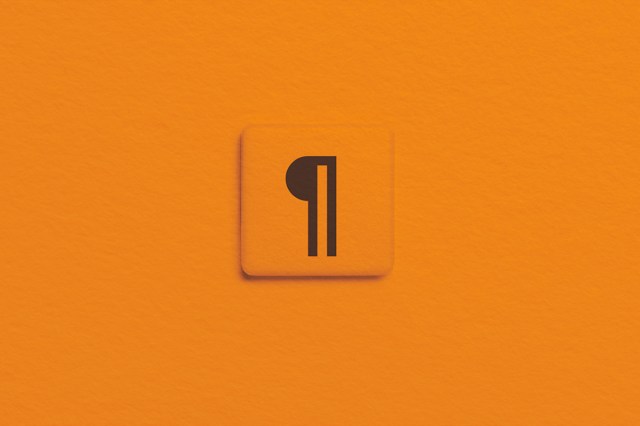
The pilcrow — a quirky backward “P” symbol — signals the start of a new thought. It once served a role in the margins of medieval manuscripts, but today it lives as an editorial mark in digital documents.
You might have noticed a curious backward “P” with an extra leg (¶) in certain editing tools or word processing systems. This strange little glyph is called a “pilcrow,” and its job is to mark the beginning of a paragraph. While it’s found today only in editing contexts, it had wider use in medieval manuscripts.
Pre-pilcrow reading was like a marathon for the brain: There were no breaks. By the Middle Ages, scribes began to use symbols to break up text, which made reading easier, but these symbols weren’t standardized. Different scribes used dashes, letters, and even personal symbols.
The first attempt at standardization came from the Latin word for “chapter,” capitulum (meaning “little head”). The modern pilcrow symbol evolved from there during the 12th century:The “C” that symbolized these breaks eventually turned into a backwards “P” with extended lines as scribes added ornate embellishments to manuscripts.
Advertisement
In the Middle Ages, the word “paragraph” could describe a distinct section of writing that was smaller than a capitulum (akin to how we use “paragraph” today), or denote the actual mark. It comes from the Greek paragraphein, meaning “write by the side.” “Paragraph” has had many variants over the centuries, including pelagraphe, pelagreffe, and pilcraft, the latter of which evolved into “pilcrow” by the 16th century.
By the late medieval period, the pilcrow symbol was a standard feature of manuscripts, used as a design element. Scribes favored drawing them in red ink, giving them visual prominence. But all good things must come to an end. Scribes often ran out of ink for such embellishments, leaving blank swaths on pages. The pilcrow’s demise was solidified with the advent of the printing press, as the hand-drawn mark slowed production. Soon, the pilcrow was abandoned, and a line break divided paragraphs instead.
Although the pilcrow largely disappeared from printed text, it never entirely vanished. It remains in editing marks in online word processors, or sometimes handwritten by editors to guide writers from one paragraph to the next. The pilcrow is a fun reminder that although many things change, some remain the same.
Featured image credit: photoopus/ Adobe Stock
Advertisement
More from our network
Word Smarts is part of Inbox Studio, which publishes content that uplifts, informs, and inspires.
Much like a fruity smoothie full of strawberries and bananas, certain words blend together quite nicely. They’re called “portmanteaus,” and you likely use some of them often.
The word “portmanteau” was created long ago for a large travel trunk capable of opening into two equal parts. It wasn’t until 1871 that the term was repurposed by Lewis Carroll, author of Alice’s Adventures in Wonderland. Carroll’s version of a portmanteau was “a word that blends together the sounds and meanings of two other words” — which is the primary usage today. If you’ve ever asked someone to brunch or checked into a motel, you’ve used one of these mashups. Here are a few of the most common portmanteaus that English speakers use regularly.
Brunch
This portmanteau combines the words “breakfast” and “lunch” in a delectable combination that denotes the meal that occurs in late morning or early afternoon — usually on weekends, sometimes including alcohol. Brunch menus tend to include both traditional breakfast and lunch fare, as the culinary lines are a bit more blurred than at other meals.
The earliest use of “brunch” dates to the late 19th century. An August 1, 1896, edition of the British magazine Punch mentions not only brunch, but also “blunch.” It reads, “The combination-meal, when nearer the usual breakfast hour, is ‘brunch,’ and, when nearer luncheon, is ‘blunch.’” Of course, the portmanteau “blunch” has faded into obscurity, whereas “brunch” has gained in popularity.
Chillax
The portmanteau “chillax” tells someone to tone it down. It blends together the words “chill” and “relax,” which are synonymous commands, and it became a popular slang alternative when it was coined sometime in the mid-1990s. Now that the ’90s are back in style, “chillax” can be revived for a quick way to warn someone to take it easy without coming across as too stern or formal.
Motel
“Motel” is a portmanteau with origins dating back to the 1920s, a time when personal motor vehicles were becoming more popular. It fuses the words “motorside” and “hotel” to refer to a type of lodging with a large parking lot, often built alongside major roadways. Nowadays, the word “motel” describes a style of hotel where each room is accessed directly from the parking lot, as opposed to through a communal lobby like in a more traditional hotel.
Biopic
Abraham Lincoln, Elizabeth II, and Mozart have all been the subject of cinematic biopics — a genre that combines “biographical” with “picture.” Biopics are movies that dramatize real events and tell the life stories of famous figures in an entertaining way. One of this portmanteau’s earliest uses came in a 1947 Variety article about Till the Clouds Roll By — a film about the life of composer Jerome Kern.
Smog
The term “smog” is believed to date to 1905, when it was used by scientist H. A. Des Voeux. He coined this term by blending the words “smoke” and “fog” to bring attention to the polluted, hazy skies throughout the British Isles. Today, there are widely considered to be two types of smog. The first is “sulfurous smog,” the type that used to plague London, which is caused by burning fossil fuels. The other type is “photochemical smog,” which is prevalent in areas such as Los Angeles, where there’s a high density of motor vehicle emissions.
Podcast
Everyone seems to have a podcast today, but we may not have had the word for these audio programs if not for Apple’s iPod, as the portmanteau combines “iPod” with “broadcast.” One of the earliest uses, if not the earliest, can be traced back to British author Ben Hammersley, who proposed the term “podcasting” in a 2004 Guardian article about the burgeoning entertainment medium. While iPods are no longer produced by Apple, this portmanteau continues to maintain its lasting appeal.
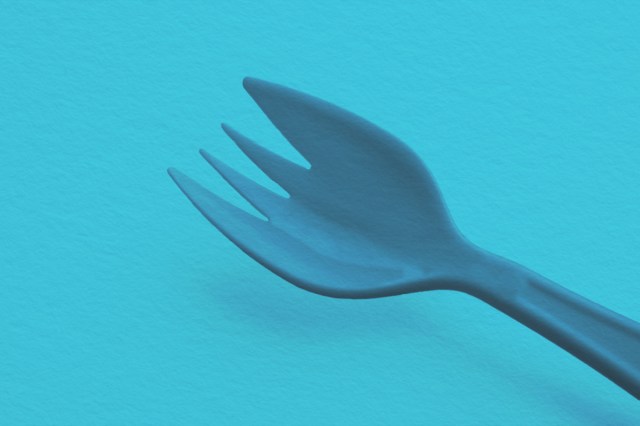
Spork
It’s a spoon … it’s a fork … no, it’s a spork! The history of this spoonlike fork dates back to before the portmanteau was coined. Dr. Samuel W. Francis filed a patent for a sporklike utensil in 1874, though it had the much more convoluted name of “Combined Knives, Forks and Spoons.” The word “spork” later appeared in a 1909 supplement to the Century Dictionary, suggesting it was coined in the intervening years. But it wasn’t until 1951 that the term was registered for a trademark, when inventor Hyde W. Ballard used “spork” to refer to a “combination spoon and fork made of stainless steel.”
Featured image credit: Pla2na/ iStock
Advertisement
More from our network
Word Smarts is part of Inbox Studio, which publishes content that uplifts, informs, and inspires.
How Do They Decide When To Add New Words to the Dictionary?
Just because a term exists doesn’t mean it’s automatically worthy of being added to the dictionary. Much like with award ceremonies, some words are inevitably snubbed while others achieve lexicographical immortality.
Dictionaries are living documents that are updated with new words each year. Recently, Merriam-Webster added more than 200 terms, from social media slang (“touch grass,” meaning “to participate in normal activities in the real world especially as opposed to online experiences and interactions”) to science jargon (“heat index,” which is “derived from a calculation using air temperature and relative humidity”). But much like how sports halls of fame induct only a select few players, dictionary editors and lexicographers don’t accept every word and slang term that comes across their desk. Their process takes into account several factors, such as the term’s longevity, popularity, and purpose. Here are some basics of how a new word makes it into the dictionary.
Merriam-Webster, one of the preeminent English language dictionaries, explains: “A word gets into a dictionary when it is used by many people who all agree that it means the same thing.” That is to say, your friend group might use a word in a certain way, but that doesn’t mean it should go straight into the dictionary. It takes time for words to spread across society, and they get added only after developing a widespread, collectively understood meaning.
Advertisement
An early step to potentially adding a new word is compiling trusted citations of it being used in articles, books, songs, and more. Researchers scour every available source, and the Oxford English Dictionary even uses crowdsourcing to bring new terms to their attention.
Beyond widespread usage, several additional criteria must be met in order for a term to be considered a worthy dictionary entry. A word should be widely understood across many regions, serve a linguistic purpose that enhances communication, and have been used for a sustained period of time. If the word meets all these criteria, it stands a better chance of making the dictionary corpus (the lexicographical term for the body of the reference book). But if a term is known to only a small group of people, or has been popular for just a few weeks, the odds of dictionary enshrinement are much less likely.
And even if a potential candidate meets all of the criteria, that doesn’t mean it’ll make the cut. It comes down to a final decision that’s made by an editor of a specific dictionary rather than some larger committee of dictionaries. Of course, some metrics are subjective, which is why some words appear in certain dictionaries and not others. However, if a word is approved, it will show up online, be published in future print editions, and is likely to trickle through to other dictionaries.
Featured image credit: Mixmike/ iStock
Advertisement
More from our network
Word Smarts is part of Inbox Studio, which publishes content that uplifts, informs, and inspires.
Some of the most common words used today actually started as mistakes. The English language is famous for its adaptability, as it borrows words from other languages and turns linguistic accidents into permanent additions. From medieval courtrooms to modern computer science, here are nine fascinating examples of words that became part of our dictionary through memorable misunderstandings.
Algorithm
An algorithm is a set mathematical process with clear steps to arrive at the right answer. But the word “algorithm” is a mistranslation of the name of ninth-century Persian mathematician Muḥammad ibn Mūsā al-Khwārizmī, which was Latinized into “Algoritmi.” So, a fundamental mathematics term comes from a mispronounced name.
Sneeze
The Old English word fnesan means “to snort.” But as writing and penmanship changed, it caused confusion between the letter “s” and the letter “f.” Fnesan became snesan — the origins of “sneeze.” Gesundheit!
Advertisement
Tornado
A tornado is a flurry of winds, maybe blowing so loudly that people couldn’t hear the correct word. The etymology of “tornado” is unclear, but it’s close enough to the Spanish words tronada, meaning “thunder,” and tornar, meaning “to turn.” A combination of the two, perhaps due to a conflation of their sounds, created the English word “tornado.”
Culprit
In the Middle Ages, the language of law was French. This word may have originated from a misinterpretation of a common abbreviation in legal documents, cul.prist. The full phrase was prest d’averrer notre bille, or “we’re ready to prove your indictment.” The abbreviation cul.prist indicated a “guilty” verdict. As English became more common, “culprit” was created by people confusing the verdict for the person.
Pea
The word “pea” is a backformation, a word created from an existing word. The original form of the green legume was “pease,” with the plural “pesen.” However, “pease” was mistaken for the plural, and people quickly began calling the singular “pea.” The mistake stuck, and now “peas” is the plural of “pea.”
Advertisement
Ammunition
Like “culprit,” “ammunition” is from French, a dominant Middle Ages language. The word la munition, meaning “weapon,” was misheard by English speakers as “ammunition,” which maintains its firing power today.
Sherry
Sherry is a strong, sometimes sweet Spanish wine. The name is commonly believed to be a misinterpretation of the Spanish vino de Xeres.
Chassé is a French ballet term, meaning “to move across the floor, jump, and bring your feet together.” But English ears heard it and wrote down “sashay,” meaning “a sassy, dance-like walk.”
Varsity
“Varsity” now strictly refers to high school sports, but it comes from “university.” It’s a shortening and misspelling based on an archaic pronunciation.
Featured image credit: Getty Images via Unsplash+
Advertisement
More from our network
Word Smarts is part of Inbox Studio, which publishes content that uplifts, informs, and inspires.
A scroll through social media comments will reveal instances of “mother” or “she’s mothering” in replies that have seemingly no relation to moms. Don’t worry — we’re here to decipher the Gen Z slang and give you a history lesson on how “mother” became a superlative worthy of a queen.
The origin is not so far off from the dictionary definition of mother: “a woman in relation to her child or children.” In the 1970s, the drag performers Crystal La Beija and Lottie LaBeija founded drag balls, events where performers would walk the runway in various fashion and culture-related categories. The performers formed “houses,” where all the members were under the tutelage of one “mother.” As some of these young LGBTQ+ drag performers had been kicked out of or left their biological families, their newly formed families and mothers provided necessary support. Crystal La Beija was the founding mother of the House of LaBeija, and Pepper LaBeija, the subject of Paris Is Burning, the award-winning documentary film about Harlem drag ball culture,followed her.
Advertisement
While “mother” began in the Harlem ball scene, it soon spread through drag culture. Many drag performers use “mother” to affectionately refer to the real-life folks who inspired them and/or their personas. These are traditionally female performers with a large gay fanbase — Judy Garland, Madonna, Lady Gaga, Rihanna, Beyoncé, and more. In recent years, Emmy-winning TV sensation RuPaul’s Drag Race has used the pageant format of the Harlem drag balls for its runway segments, and the contestants on the show often call host RuPaul “mother” because of her influence in the drag community. RuPaul has embraced the title with a hit dance song, “Call Me Mother.”
But the social media “mothers” aren’t exclusively from drag queens. In recent years, the slang has leapt into the Gen Z lexicon as a way to express affection and respect for all kinds of women. If someone is demonstrating a particular level of fierceness or elegance that looks like it could belong on the runway, you might say, “She mothered so hard with this one,” or give a succinct “mother” as a sign of your appreciation or admiration.
Featured image credit: dvulikaia/ iStock
Advertisement
More from our network
Word Smarts is part of Inbox Studio, which publishes content that uplifts, informs, and inspires.
The word for “mom” might sound different depending on where you are, but the feeling is universal. From the cheerful “mami” in Spanish to the sophisticated-sounding “maman” in French, every culture has its own take on what to call the most important person in the room on Mother’s Day. While many of these languages share similarities — many start with “m” or include “ma” and “mama” sounds — each has its own cultural ties and flair.
"Mama" — A Universal Term
Some words transcend language barriers, and “mama” is one of them. “Mama” is a go-to moniker in German, Polish, Indonesian, Filipino, Finnish, Swahili, and Japanese (ママ, “mama”) — and in Italian and Swedish it receives an extra “m” for mamma. It has slight spelling and vowel variations in other languages, as seen in Ukrainian (мама), Greek (mamá), Romanian (mamă), and Mandarin Chinese (妈妈, māma), and in Māori, the language of the Indigenous Polynesian people of New Zealand, it’s māmā (pronounced with a long “a”).
While the origin of “mama” is uncertain, the Oxford English Dictionary says it’s probably a duplicated syllable of /ma/ — a common early vocalization of infants. Because of this, it’s plausible that all similar words for mom — including “momma,” “mammy,” “mum,” and “mom” — are ultimately related by babies’ capacity for language, spanning centuries, oceans, and cultures.
Advertisement
In Some Languages, "Mom" Changes by Region
While many cultures have a word like “mama,” there are plenty of other names to call mom, and in some languages, the version you use depends on where you live. Vietnamese has more than a dozen variations of “mom.” It’s a tonal language, and words can vary based on geography. Generally speaking, you could say mẹ (the most common modern word for “mother”) anywhere in Vietnam and be correct — but other variations depend on regional dialects.
In Northern Vietnam, including Hanoi, mợ, a diminutive of mẹ, is very popular, while in the countryside, you’d be more likely to hear bu or bầm. In Central Vietnam, mạ (derived from the Chinese word 妈妈 or mama) is common. The underdot tone mark indicates a low-dropping tone, but to the south, má receives a high-rising tone mark instead.
Titles for mothers vary by region in Spanish as well. While mamá (“mom”) and madre (“mother”) are universal, there are plenty of regional Spanish words for “mom.” For example, the diminutive suffix “-ita” is added to mamá as a term of endearment, but in Latin America, it’s written as mamita, and in Spain, it’s mamaíta. Similarly, mamacita is the equivalent of English’s “momma” in Mexico and Central America. Mamá is also often shortened to ma or amá, which is especially popular in Mexico.
Another regional slang term for “mom” in Spanish is Argentina’s mamucha. In Mexico and some South American countries, vieja (“old lady”) and viejita (“little old lady”) are used affectionately to refer to one’s own mom. And one of the most endearing slang options for “mom” comes from Mexico, where jefe (meaning “boss”) refers to mom. It’s often seen with a twist, as in jefita (“little boss”) or jefecita (“little boss lady”), using diminutive suffixes to show fondness.
Advertisement
Other Words for "Mom"
With thousands of languages worldwide, it’s no wonder there are so many ways to say “mom.” Some are classic, while others are surprising, quirky, or even confusing, but they all share one similarity. They carry a special sense of warmth and familiarity that transcends language.
In American English, we might favor “mother,” “mom,” “mommy,” and “mama,” but across the globe, there are hundreds of words for this special person.
What’s the Difference Between Straight and Curly Quotation Marks?
Straight and curly quotation marks may look largely similar. But when it comes to deciding between the two, there’s a “smart” choice and a “dumb” choice to be made.
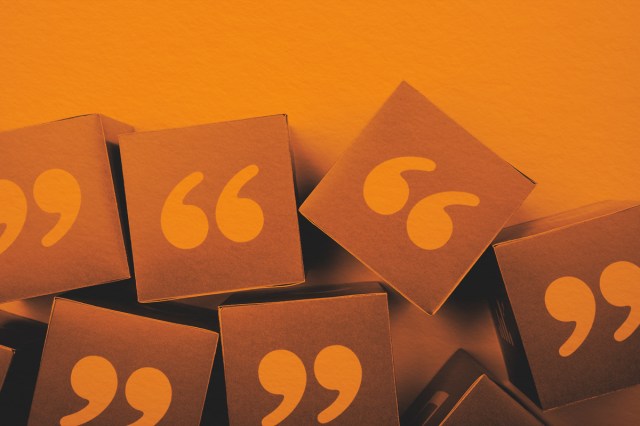
Much like the shape of french fries, there is a choice between straight (“”) and curly (“”) quotation marks (no waffle or shoestring quotation marks to confuse the issue even more). Funnily enough, while they look different, they don’t differ in their meaning, as straight and curly quotation marks serve an identical grammatical purpose. However, they do cause some issues when it comes to typography and now computers, and thanks to modern computer programmers, straight quotes started to be called “dumb” and curly quotation marks were called “smart.” Here’s how they acquired those reputations.
Curly quotation marks were preferred by the earliest printers for their stylistic appeal. They were the standard choice until the typewriter was invented in the 1870s. In an effort to consolidate space on typewriter keyboards, early models included a single straight mark (‘) key to serve a variety of purposes. This single ambiguous line could act as an apostrophe if typed once or quotation marks if typed twice, and could also be used for measurements in feet or inches (e.g., 5’4”). This choice was more efficient than dedicating multiple keys to open and close curly quotation marks and an apostrophe. It freed up valuable keyboard real estate for other symbols.
In the 1960s, ASCII (American Standard Code for Information Interchange) was designed for word processors. The digital system didn’t have the same physical limitations of a typewriter keyboard, but ASCII still adopted straight quotation marks, rather than revert to the curly symbols that many typographers preferred. The smart/dumb distinction developed as personal computer technology evolved. In the 1980s, software developer David Dunham wrote an algorithm he called “Smart Quotes,” which replaced ‘ and ” with ‘ or ’ and “ or ” automatically as the user typed. At that point, the straight versions were still standard on Macintosh computers and, as Dunham described, “you used to have to remember some arcane keyboard combinations to enter curved quotes.”
It seems that thanks to Dunham’s algorithm, straight quotation marks got the reputation of being “dumb,” whereas curly ones came to be known as “smart.” While there really is no grammatical difference between the two, straight quotation marks were phased out for the more popular curly quotation marks as word processing technology developed. All this is to say that the difference between straight and curly quotation marks is largely a style choice, though it’s one that many have strong feelings about. Common typography wisdom says that you should never use straight quotation marks, as they’re simply a vestigial relic of early typewriters, and some computer programs don’t render them properly. Instead, curly quotation marks are considered preferable due to their aesthetic appeal and also the fact that they came first. We’re of the opinion that it doesn’t really matter, but you should pick one and be consistent within the piece.
Featured image credit: mattjeacock/ iStock
Advertisement
More from our network
Word Smarts is part of Inbox Studio, which publishes content that uplifts, informs, and inspires.
Enter your email to receive daily lessons that dive into what makes English so fascinating. Each email is packed with odd rules, etymologies, and the tools you need to be a better communicator.
Sorry, your email address is not valid. Please try again.
Sorry, your email address is not valid. Please try again.