
5 MIN READ

The Bouba-Kiki Effect — What the Sound of Your Name Might Say About You

Does the sound of your name have any bearing on your personality? Maybe the bouba-kiki effect has the answers.

by Tony Dunnell
Different baby names written on paper, closeup

Have you ever wondered what, if anything, your name says about you? While parents usually put a great deal of thought and care into choosing names for their babies, these are typically given without any input from the recipient. Therefore, it would be logical to think that, really, our names say very little about who we are as individuals. But that isn’t necessarily the case — our names might actually have some say in how others perceive us, at least initially. But why? Here’s a look at how, when it comes to names, some sonic signatures could influence first impressions and personality associations in thought-provoking ways.

The Bouba-Kiki Effect

In 1929, German American psychologist Wolfgang Köhler carried out an elegantly simple experiment. He showed test subjects two shapes: one rounded and cloudlike, the other sharp and spiky. He then asked them to assign one of the made-up names “takete” or “maluma” to each shape. He found that an overwhelming majority of people matched “maluma” with the rounded shape and “takete” with the angular one. The experiment revealed a strong link between meaningless speech sounds and geometrical shapes — the softer-sounding word was associated with the rounded shape, and the harsher-sounding word with the spiky shape.  

Later, in 2001, UCSD scholars V.S. Ramachandran and Edward Hubbard repeated the experiment. Using similar shapes to Köhler’s experiment, they gave people a simple task: “In Martian language, one of these two figures is a ‘bouba’ and the other is a ‘kiki,’ try to guess which is which.” A resounding 95% of people picked “bouba” for the smooth, rounded figure, and “kiki” for the spiky one. This became known as the bouba-kiki effect. The experiment was later carried out across different cultures and languages, with similar results.  

So what, exactly, is going on? It isn’t entirely clear why the phenomenon occurs, but Ramachandran and Hubbard believe it may be due to connections between the sensory and motor areas of the brain. In the experiment, the visual shape of the object — round or spiky — is linked to the shape that our lips make when we say that corresponding word, with “bouba” producing open and rounded lip shapes, and “kiki” narrow and wide. In general, the experiments revealed that people — through the physical experience of both saying and hearing sounds — tend to associate sharp words to spiky objects, and softer words with rounder objects. 

Advertisement
The Sound of a Name

The bouba-kiki effect shows how nonwords such as “bouba,” “maluma,” “takete,” and “kiki” can be associated with certain shapes, but what does this mean for the most personal of words, our own names? Cognitive psychologist David Sidhu and psycholinguist Penny Pexman tackled this very question, and they found that sound symbolism is not limited to nonwords, and that the bouba-kiki effect could apply to recognizable given names as well as nonwords. 

According to Sidhu and Pexman, individuals do associate certain personality traits with first names, solely on the basis of the sounds the name contains. Using shapes similar to those used by Köhler, Ramachandran, and Hubbard, their study found that certain first names, such as Bob and Molly, were perceived as round, and others, such as Kirk and Kate, as spiky. A similar study was carried out in French, with similar results: a round-sounding Benoit versus a spiky Éric.

Talking to the BBC, David Sidhu explained how the sounds of given names are perceived: “Smoother-sounding names like Molly get associated with things like being more agreeable, more emotional, more conscientious, whereas the harsher, spikier-sounding names are thought of as being more extroverted.” Names that are rich in soft, rounded sounds — for example, Bobby, Emma, or Liam — tend to be associated with warmth, approachability, and gentleness. In contrast, names featuring harder consonants and sharper sounds — Kirk, Kate, Viktor — can be perceived as energetic, projecting qualities such as strength, competence, and decisiveness. 

Advertisement
Do Names Shape Our Personality?

Don’t start agonizing over your own name — or what to call your baby — just yet. Sidhu and Pexman tested whether any actual link exists between a person’s name and their personality, perhaps as a result of a round or spiky name influencing its owner. They found no such association. Their data suggests that a first name is highly unlikely to influence a person’s actual personality traits — at least not beyond any biases held by other people. 
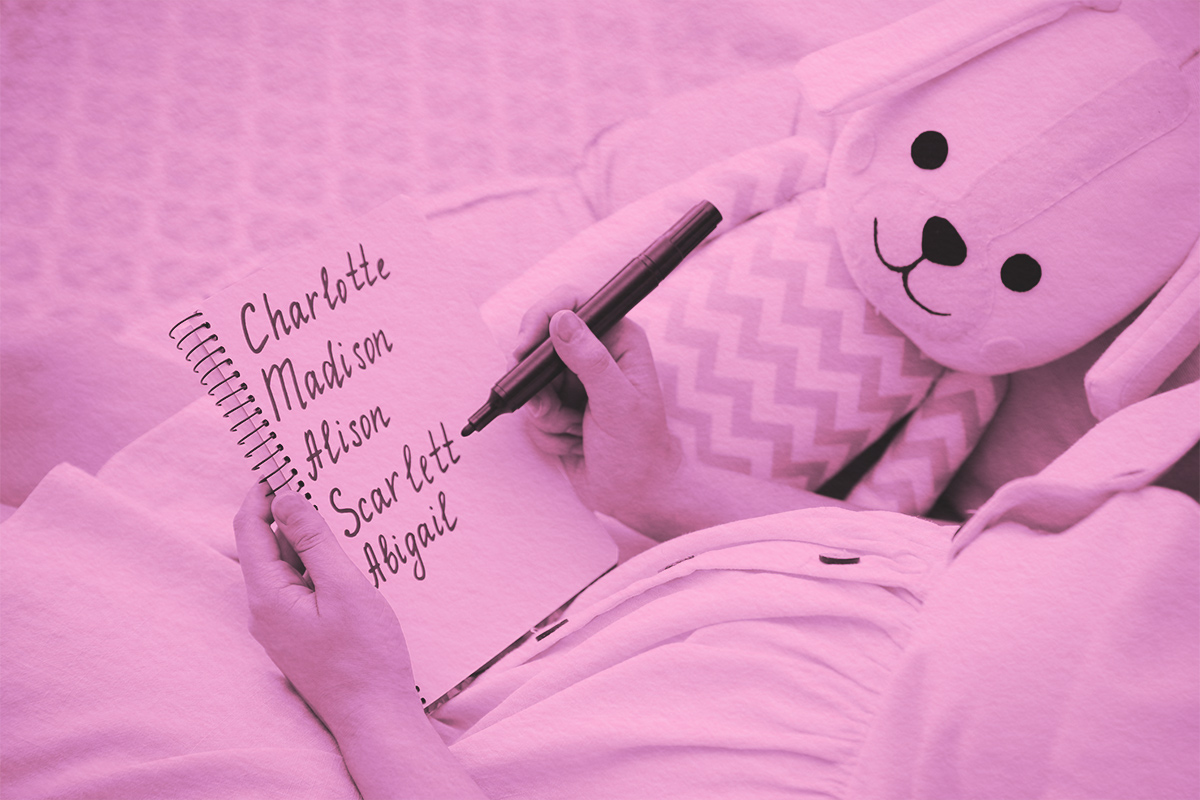
According to Sidhu, the way a name sounds can play a role when that’s all someone knows, much like in his and Pexman’s studies — and it can potentially affect people’s first impressions. “But as you start getting more information about the person,” he says, “then that actual information about the personality is probably going to override these biases.” Your name, therefore, is unlikely to shape your personality in any significant way — but the bouba-kiki effect does remind us that language and perception are deeply intertwined, and simple sounds can carry more weight than we typically recognize.

Featured image credit: Liudmila Chernetska/ iStock
4 MIN READ

Decoding the Language of the Football Huddle 

Even the most avid NFL fan may not always fully comprehend what’s being discussed on the field and by analysts. Here’s a closer look at the coded language of football players and coaches.

by Bennett Kleinman
Group of men getting ready to play football

Despite both being native English speakers, someone from the Northeast may struggle to understand every regionalism spoken by someone from the Deep South. The same is true when it comes to football, where players, coaches, and even TV analysts use coded jargon that often goes over the heads of some fans.

Just think of the last time you watched a football game. Whether you were in the bleachers, close to the high school action, or hearing miked NFL players on TV, you might have heard the quarterback using a bunch of seemingly random words while calling plays. It’s all part of a coded language meant to convey secret messages to teammates. Those words, numbers, and letters have a deeper meaning. Here’s a closer look at how to decode football jargon.

A Universal Language

Basic terms such as “touchdown,” “interception,” and “first down” are widely understood by both fans and players alike. Less clear, however, is why a quarterback may shout “Linda” before a snap, or what the word “tundra” means in the context of the gridiron.

Teams use different specific words in an effort to keep their playbooks shrouded in mystery, but there are general concepts that guide the lingo. If the words were the same across the NFL, then the opposing defense would know exactly what play was coming all the time. Coaches change it up from team to team, while still following overarching guidelines that players are familiar with, so the teams can quickly learn and memorize new plays.

For a look at the bigger picture, we turned to an interview between sports podcaster Pablo Torre and former college quarterback Nate Tice, in which Tice elaborated on some of the more common terminology used on the gridiron. 

Advertisement
A Closer Look at the Code

Usually this coded language is based on the first letter of a word. For instance, if the quarterback uses a word starting with “R” or “L,” they’re instructing players to run either right or left. In a clip shown during Tice’s interview with Torre, New York Giants head coach Brian Daboll mentioned that the team uses “Rita” instead of “right” and “Linda” instead of “left” (now you’re in on the secret). Each coach is likely to rely on a unique “R” and “L” word for this same directional purpose.

“D” words and “T” words, on the other hand, are widely used as a way to instruct players about where they should stand when lining up. On a typical play, the offense might have four eligible receivers (e.g., wide receivers, tight ends). If the coach wants two receivers on each side of the ball (“doubled”), they’ll call a play using a “D” word such as “dolphin.” But if the coach wants three receivers on one side and a single man on the other side, they’ll use a “T” word (code for “triple”) such as “trips” or “trio.”

The numbers tell the blockers what type of protection they need to provide and which direction they need to go. Again, each team determines what their numbers mean specifically, but players moving from team to team know the general category numbers designate. 

Lastly, it’s important for the play caller to tell receivers what routes to run. For instance, Tice brought up the word “float” — a portmanteau of the words “flag” (which is a synonym for “corner” in the world of football) and “out.” If the receivers hear the word “float,” they know to run out toward the corner. “Tundra,” on the other hand, means “two under.” So a “tundra” call means that two receivers would run an under route. 

Some of these words and phrases are more intuitive than others — a weekend football fan might not be able to step into the huddle and immediately translate the plays, but the formula allows football players to pick up new play calls more easily. The next time you’re watching a game, listen for words that start with “L” or “R,” and “D” or “T,” and see if you can accurately predict which play is coming. You may be surprised to find how easy it is to follow along with the analysts. 

Featured image credit: Getty Images/ Unsplash+
2 MIN READ

Why Is It Called a ‘White Lie’?

While it’s rarely good to lie, sometimes telling a harmless mistruth can help avoid hurting someone’s feelings. These tiny fibs are called “white lies.” Let’s examine why.

by Bennett Kleinman
Man crosses his fingers with both hands behind his back

Have you ever pretended to love a holiday gift, even though it’s something you didn’t need? Or complimented a friend’s outfit, despite the fact that it’s not really your style? If so, you told a white lie: “a lie about a small or unimportant matter that someone tells to avoid hurting another person.” While this term holds a place in the modern lexicon, its origins are centuries old.

According to the Oxford English Dictionary, one of the earliest known written examples of the phrase dates to April 10, 1567. It appeared in a letter sent by one Ralph Adderley to a Sir Nicholas Bagnall, reading: “I do assure you he is unsuspected of any untruth or other notable crime (except a white lie) which is taken for a Small fault in these parts.” But we don’t know that Adderley coined the term, just that he penned an early surviving example.

The origins of “white lie” are believed to stem from ancient associations between light and purity or good, whereas darkness often represented evil. Things that were described as white or portrayed in lighter hues were considered less likely to cause harm. The phrase “white lie,” even in the 16th-century context, suggests that the fib being told is more pure in its intentions and thus less likely to hurt anyone’s feelings.

This begs the question: Did people ever use “black lie” to describe more malicious lies? Yes, as evidenced by a 1741 gossip column from The Gentleman’s Magazine. An excerpt reads: “certain Lady of the highest quality … makes a judicious distinction between a white and a black Lie.” But while the more nefarious “black lie” has largely faded from use, people still have use for the wholesome “white lie,” and it remains in the modern lexicon.

Featured image credit: mikespics/ iStock
2 MIN READ

What Is a Synecdoche?

Have you ever said “Nice wheels!” to someone while complimenting their car? If you have, you’ve used a synecdoche (pronounced sih-NEK-duh-kee). This figure of speech is something that most of us use often, maybe even daily, but it’s not usually identified by name outside of an English or public-speaking class. Let’s explore one of rhetoric’s […]

by Rachel Gresh
Family of three admiring the interior of a car

Have you ever said “Nice wheels!” to someone while complimenting their car? If you have, you’ve used a synecdoche (pronounced sih-NEK-duh-kee). This figure of speech is something that most of us use often, maybe even daily, but it’s not usually identified by name outside of an English or public-speaking class. Let’s explore one of rhetoric’s most underrated tricks.

A synecdoche is an expression that uses a part to stand for a whole. For instance, “wheels” represents a whole car — when praising someone’s “nice wheels,” you obviously aren’t complimenting only their tires. In the same way, the expression “mouths to feed” refers to hungry people, with “mouth” representing part of a whole person. “Faces in the crowd” and “hand in marriage” are other common examples of synecdoche  using body parts to replace people or a person.
A synecdoche also can be composed in reverse, using the whole to describe a part, as in “Kansas City won the 2025 Super Bowl.” Here, the name of the entire city is used to describe part of it: the football team.

Metonyms and synecdoches are closely related, but they’re not exactly the same. A metonym employs a word that is closely associated with a concept to stand in for it, such as “the crown” for the British monarchy or “the press” for journalists. This tool is less literal and more metaphorical.

So, the next time you hear someone say, “All hands on deck!” or ask, “What’s the head count?” you’ll know a synecdoche is hard at work to add a little more flair into daily conversations.

Featured image credit: Olena Miroshnichenko/ iStock
5 MIN READ

Gen Z’s Favorite Slang Just Made It Into the Dictionary

We’re bridging the generation gap with dictionary-approved slang — one skibidi word at a time.

by Rachel Gresh
Low angle view of phones covering up the faces of gen z students

You might think the dictionary is a resource to improve your vocabulary with words such as “quixotic” and “ephemeral” — sophisticated words with impressive pedigrees. But these days, the reference is also home to “skibidi,” “delulu,” and “rizz.” The lexicon of Gen Z and even Gen Alpha, generations raised on iPads, memes, and TikToks, is now officially part of the English language.

In the 12th edition of Merriam-Webster’s Collegiate Dictionary (releasing on November 12), we can expect a collection of new internet slang, capturing how younger folks communicate both online and in everyday conversations. Cambridge Dictionary also added more than 6,000 words this year, including some of today’s most viral slang.
Now, we aren’t “delulu” — we know you probably won’t use these terms in your everyday life — but it’s nonetheless helpful to know them to keep up with how the younger generations are speaking today. 

Delulu

Delulu” is a playful distortion of “delusional.” Specifically, this adjective means “believing things that are not real or true, usually because you choose to.” It mimics similar reduplications in English, such as “boo-boo” or “choo-choo.” Its popularity has skyrocketed over the last decade, and it has continued to gain ground this year, especially with its new Cambridge Dictionary entry.

How to use it: “I signed up for golf lessons, and I’m delulu enough to think I’ll be a pro by next summer.”

Doomscroll

This harmful modern habit involves spending excessive time online scrolling through upsetting news or social media content that leaves you feeling sad, anxious, or angry. Doomscrolling might also be referred to as “doomsurfing,” though the latter term hasn’t earned itself a place in the dictionary (yet).

How to use it: “I was late to work this morning — I got caught up doomscrolling instead of getting ready.”

Advertisement
Dumbphone

In contrast to today’s smartphones, a dumbphone is what we used before the age of the iPhone and its competitors. Think of a standard flip phone from the early 2000s. That’s a textbook “dumbphone.” No advanced software, internet access, or apps — just calling and texting. So why is the word relevant enough to be added to the dictionary now? As it turns out, many young people are buying dumbphones to escape digital overload and reconnect with the real world in a movement called “digital minimalism.”

How to use it: “I bought a dumbphone to reduce my screen time and encourage myself to try new hobbies.”

This noun-turned-verb for ordinary tasks required of a responsible grown-up has been around for more than a decade, but it finally earned its place in the pages of Merriam-Webster this year. It’s usually used with a playful or sarcastic tone to lighten the mood or express distress or annoyance. After all, being an adult is hard work.

How to use it: “I totally forgot to pay my quarterly taxes — adulting is hard.”

Broligarchy

A clever portmanteau of “bro” (brother) and “oligarchy,” “broligarchy” is an informal noun for a small group of wealthy and powerful men involved in technology businesses who also exert political influence. According to the BBC, the term first gained popularity when used to describe tech moguls including Jeff Bezos and Mark Zuckerberg, who hold sway over politics.

How to use it: “The new startup is run by a broligarchy of college pals looking out only for themselves.”

Advertisement
Cancel Culture

This phenomenon refers to the mass “canceling” (shaming) of someone or something as a way of expressing disapproval, typically through social pressure. Cancel culture is especially prominent online and on social media. Since emerging around 2016, cancel culture has become a major topic regarding free speech and accountability.

How to use it: “Cancel culture has sparked debates about public shaming in the digital age.”

Hard Pass

If something requires an emphatic “no,” it’s a “hard pass.” This noun phrase is a firm refusal or a rejection of something. It comes from the idea of passing on or refusing something, as in, “‘Would you like some coffee?’ ‘I’ll pass, thank you.'” This is a more intense version of that, with “hard” indicating a more assertive answer.

How to use it: “The forecast looks like it’s going to rain during the concert tonight. Hard pass.”

Rizz

If you have rizz, you have “romantic appeal or charm.” This colloquialism is a shortening of “charisma” (“a special magnetic charm or appeal”). The term was added to Merriam-Webster this year, and in 2023, it was Oxford’s Word of the Year. It was popularized by an American content creator, Kai Cenet, in 2022, as he advised his viewers on how to have rizz.

How to use it: “Elvis didn’t just sing — he had rizz before the word even existed.”

Skibidi

Skibidi” is so catchy to younger generations that frustrated teachers have banned it from classrooms. It’s an adjective that is essentially nonsense, but its Cambridge Dictionary entry defines it as “a word that can have different meanings, such as ‘cool’ or ‘bad,’ or can be used with no real meaning as a joke.” It’s derived from an obscure YouTube show about evil toilets (yes, you read that correctly).

How to use it: “What the skibidi is going on?”

Tradwife

A blend of “traditional” and “wife,” this term originated on TikTok and Instagram, where married women who are homemakers create content involving cooking, cleaning, raising children, and other stereotypical housewife activities. “Tradwife” can also refer to the genre of social media influencing that has gained significant traction over the last decade, as in “tradwife content.”

How to use it: “Check out this recipe for blueberry sourdough bread. It’s from a tradwife influencer on TikTok.” 

Featured image credit: Xavier Lorenzo/ iStock
2 MIN READ

Who Is Susan of ‘Lazy Susan’?

Found in kitchens around the globe, the lazy Susan has revolutionized the dinner hosting game. Here’s how it earned its unusual title.

by Rachel Gresh
lazy susan sits on kitchen counter

How did such a useful kitchen accessory earn such a lackadaisical name? There are several clues as to the etymology of this peculiar moniker. Tracing the origins of the device and the name lead us on different paths, and the name is a surprisingly modern invention. 

Rotating trays have existed in kitchens around the world for centuries. They’re popularly used in Chinese restaurants, where they’re called cānzhuō zhuànpán or simply dinner-table turntables — pretty straightforward. But in the American kitchen, they boast an interesting name: lazy Susan

Susan likely wasn’t a real person, despite what some folk etymologies say about Thomas Jefferson, who neither invented the lazy Susan nor had a daughter named Susan. Instead, this term likely stems from an 18th-century practice of using the name Susan as a generic title for a household servant. Because these trays make serving easier without the need for extra help, “lazy” was tacked on, perhaps as a marketing tactic. 

According to a Q&A in the Chicago Tribune, one of the first published mentions of “lazy Susan” dates to an ad in a 1917 issue of Vanity Fair, specifically a Christmas promotion that highlighted household gifts. Here’s how the copywriter described this sensational kitchen device: “$8.50 forever seems an impossibly low wage for a good servant; and yet here you are; Lazy Susan, the cleverest waitress in the world, at your service!” 

At that time, World War I was being waged across the Atlantic, and women in the U.S. were likely looking for ways to increase efficiency in their homes. It seems that a humble serving tray, one that cleverly rotates and bears a slightly off-putting name, was the answer to their troubles. We prefer the name lazy Susan to another hostess helper: the dumbwaiter. This unfortunately named tool is either “a portable serving table or stand often with revolving shelves arranged in tiers” or “a small elevator used for conveying food and dishes or small goods from one story of a building to another.”

Featured image credit: JTobiason/ Adobe Stock
4 MIN READ

Who Invented Punctuation?

While it’s sometimes tricky to know how to properly use a semicolon, and English majors love to debate Oxford commas, we’d be lost without punctuation marks. But written language existed long before em dashes and exclamation points. Who invented punctuation marks?

by Stewart Edelstein
A period, question and exclamation mark post it notes

CANYOUREADTHISIBETITSHARDWITHOUTPUNCTUATIONITSHARDTOREADEVENSHORTSENTENCES 

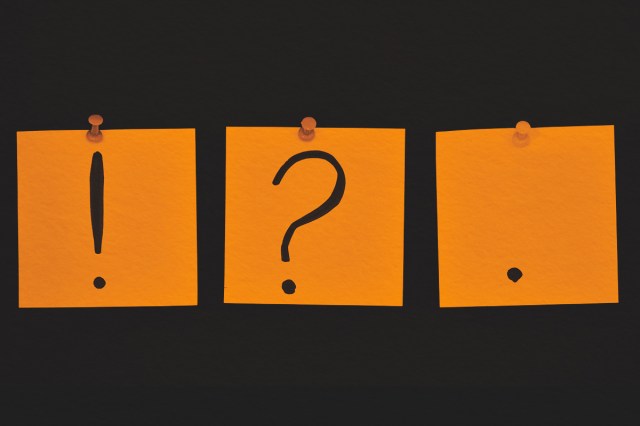
Can you read this? I bet it’s hard. Without punctuation it’s hard to read even short sentences. Initially, ancient Greek was written in all caps with no punctuation or spacing. We even find inscriptions from ancient Rome written in all caps with only small dots breaking up the words. Speech, especially the eloquent and persuasive speech of politicians and elected officials, was valued more highly than the written word. But now punctuation makes all the difference. For example, the versatile “OK” can be a question (“OK?”), an agreement (“OK.”), or an exasperated exclamation (“OK!”). So, where did these punctuation marks come from?

Aristophanes of Byzantium, a third-century BCE Greek grammarian, introduced punctuation marks based on three dots, placed in high, middle, and low positions after a letter, designating the end of different types of sections — what we would now call sentences, paragraphs, and perhaps chapters as the longest sections. The dot system was adopted by the Romans and developed by using additional points to separate each word. Aristophanes’ system of dots was further expanded through the rise of Christianity in the fourth and fifth centuries. To spread the word of God, Christians preferred the written word, made clearer with punctuation. 

In the seventh century, Archbishop Isidore of Seville updated Aristophanes’ system, rearranging the dots so that pauses were short (low dot), medium (middle dot), or long (high dot) — our comma, colon, and period, respectively. Isidore’s breakthrough was to associate punctuation with meaning for the first time. The archbishop’s system used dots within sentences, and ends of sentences might have been marked with a group of two or three dots.

Advertisement

The question mark evolved from the punctus interrogatives created by eighth-century English scholar Alcuin of York, used to signal an upward inflection at the end of a sentence. The original form was a diagonal line above the last letter of the last word in a sentence, but it eventually morphed to the curled question mark we use today. The exclamation mark is from the Latin io, meaning “joy,” which medieval scribes wrote at the end of a sentence to express that emotion. In all caps, an “I” with an “O” below it (to save space) became the exclamation mark, with the “O” shrinking to a dot over time.

In 1494, Italian printer Aldus Manutius invented the semicolon. Its initial purpose, a pause the length between that of a comma and a colon, was revealed in its very form, combining half of each of those marks. Manutius also notably contributed to the development of punctuation by writing on its main purpose: clarifying syntax. 

By the height of the Renaissance, a hodgepodge of punctuation marks were found across writings, but the Gutenberg Bible, published around 1455, changed all that. Within 50 years of that publication, most punctuation marks that we use today were established, likely due to the increased use of the printing press. However, the rules guiding the usage of punctuation marks wouldn’t become standardized for some time. 

Those rules were established by the 17th century. A period (.) marks the end of a complete sentence or to mark abbreviations. The colon (:) indicates the beginning of a list, summary, or quotation. As it was originally intended with its pause length, the semicolon (;) serves a job halfway in between a comma and a period; it can substitute a period between two grammatically complete sentences that are closely connected. A comma (,) serves many roles. It can indicate a pause, going back to the original use of dots, and it can separate items in a series. It also may be used to set off information or before a coordinating conjunction (such as “and” or “but”) and a complete clause. Standard English language punctuation marks also include quotation marks, apostrophes, hyphens, dashes, parentheses, ellipses, and more, and the rules are detailed and contain many exceptions. 

Featured image credit: lisica1/ Adobe Stock
2 MIN READ

Should I Use ‘Less’ or ‘Fewer’?

Less is more, except when you should be using the word “fewer” instead. Here’s a quick explanation as to when you should use each of these two similar words.

by Bennett Kleinman
Stairs of letter tiles reading less

The words “less” and “fewer” are like a set of identical twin babies. It may seem difficult to distinguish between the two at first, but there are subtle differences that parents know to look for. Learning how to use these words properly isn’t as important as identifying your children, of course, but it’s still worth knowing.

The general rule of thumb is to use “fewer” when discussing things that can be counted, such as “fewer children” or “fewer books,” and to use “less” when the context is a measurable quantity, such as “less water” or “less rice” (you wouldn’t count individual grains of rice). While “less” is generally used for measurable quantities and “fewer” for countable amounts, there are some exceptions that muddy the waters a little bit.

For example, units of time are countable, but when using these comparative words, it fits better under the measurable quantity umbrella. It makes more sense to say “I have less than 24 hours to finish the project. “Less” is also used in comparisons of distance (e.g., “less than 10 miles”), money (“less than a dollar”), and weight (“less than 5 pounds”). That’s because people generally treat those concepts as measurable amounts rather than exact countable numbers. These examples show that despite a general rule, there is almost always an exception when it comes to the English language. 

Despite these distinctions, the confusion is understandable because “less” and “fewer” were once used interchangeably. That shifted in the late 18th century, at least in part due to writer and grammarian Robert Baker’s Remarks on the English Language, in which he discussed his own personal preference for when to use “less” vs. “fewer.” In time, people adopted Baker’s opinion as conventional wisdom, essentially redefining each word in line with the modern usage.

Featured image credit: cbies/ iStock
5 MIN READ

What Your Handwriting Says About You

According to graphologists, our handwriting can reveal much about our personalities, laying bare our souls through the dotting of an “i” or the crossing of a “t.”

by Tony Dunnell
Close-up of notebook with writing inside

Handwriting is one of our distinct biometric traits, just like our fingerprints, iris, face, voice, and gait — all of which, to varying degrees of reliability and uniqueness, can be used as physical identifiers. For at least a century, handwriting analysts have helped solve a wide variety of criminal cases by examining a suspect’s writing, normally by comparing and matching handwritten samples. And then there are graphologists, who take the examination of handwriting even further, seeing it as a direct expression of our personality. They look at various aspects of our handwriting — from the size of our letters to how we dot an “i” or cross a “t” — with each element potentially revealing a wealth of information, such as our confidence levels, emotional state, and even our general approach to life. 

Here we take a look at some of the key components that graphologists look for when examining handwriting, and what each element can say about us. It’s important to remember, however, that graphologists don’t normally focus on just a single, isolated symbol — it’s best to consider the various elements as a whole to get a bigger and potentially more accurate personality profile. 

Furthermore, graphology is not the precise study that handwriting analysis provides — take the assumptions about certain personality traits and their connection to handwriting with a grain of salt. Just because you form your letters in a certain way doesn’t mean you’re destined for a particular outcome. Instead, have some fun with the possibilities of graphology and what your handwriting might reveal.  

Advertisement
Emotional Indicators

The amount of pen pressure a person uses when writing is a key indicator of emotion for graphologists. A writer using heavy pressure (meaning the imprints of their handwriting can be felt on the other side of the page) is thought to be displaying more emotional intensity. More generally, heavy pressure writers often have strong constitutions and enjoy being active but may also be temperamental or irritable. Soft pen pressure, on the other hand, can be indicative of a yielding, hesitant personality. According to an interview with graphologist Annette Poizner in Reader’s Digest, “This may be somebody who grew up with a dominant or aggressive caretaker or sibling and never learned how to be assertive.” 

The way you dot your lowercase “i” also can be particularly telling. A small, precise dot directly above the letter stem suggests someone who is detail-oriented, precise, and methodical. But if the writer replaces the standard dot with a round circle — or even a small smiley face — it’s a strong sign of playfulness (or a desire for attention). A hastily drawn dot that turns into a small, sharp line, on the other hand, could be a sign of irritation or anger.

A preference for strong angularity, similarly, may indicate irritability and anger-management issues, but also honed critical thinking and debating powers. On the other hand, the presence of loops and rounds can indicate a writer with a more expressive, emotional, or sensitive state of mind. 

Advertisement
Introvert vs. Extrovert

The angle at which your letters lean can reveal whether you are an extrovert (right slant) or introvert (left slant), as can the size of your handwriting. Large, bold letters often belong to extroverts who enjoy being noticed and appreciated. These writers tend to be self-confident and may do well in leadership roles and social situations. Small writing often indicates the opposite — an introvert. According to graphologist John Beck, “The small writer by contrast does not like to be noticed, takes up an analytical attitude to everything, and likes to play a low social profile.” If your writing is medium-sized, it may represent a more balanced personality that can adapt well to different social situations.

Spacing comes into play, too. Generally speaking, the space between handwritten words tends to be about the width of one letter (a good rule of thumb being the width of a lowercase “o”). Gaps that are wider or narrower than normal can be revealing. Wide spacing may indicate that a person values their freedom highly, and particularly dislikes feeling overwhelmed or crowded. Narrow spacing suggests that the writer might crave contact with other people, doesn’t like being alone, and is possibly a bit needy.  

Cursive vs. Print

Graphical continuity — the way in which letters connect with each other in each word — is one of the fundamentals in handwriting. As children, we are taught cursive (joined-up) handwriting and print handwriting. What we stick with as adults can reveal information about our way of thinking. People who connect their letters apply logic over emotion — and might also be more conformist, conventional, and predictable. Conversely, disconnected letters might suggest someone who thinks more intuitively or creatively, and acts more on instinct. These shunners of cursive might well prefer to work independently and may be naturally artistic or inventive.

Featured image credit: Hiraman/ iStock
2 MIN READ

Why Do We Say ‘How the Tables Have Turned’?

While turntables are found in DJ booths, the phrase “how the tables have turned” originated in an entirely different entertainment medium.

by Bennett Kleinman
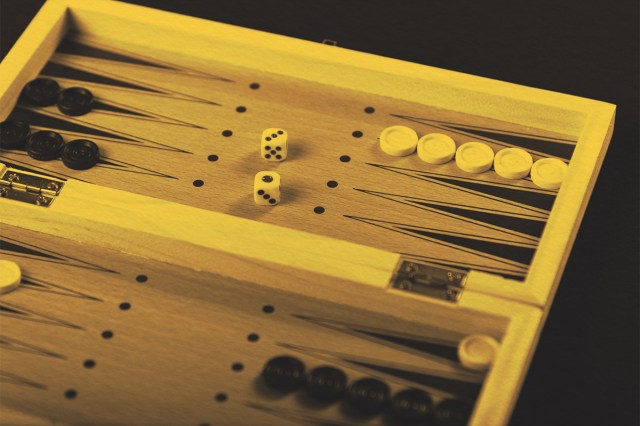
Board for playing backgammon with pieces and dice

Unless you’re eating a family-style meal with a lazy Susan in the middle, you’ll find that most tables aren’t designed to turn. This begs the question: How did “how the tables have turned” (or, if you’re a fan of The Office, “how the turn tables”) become a common expression? According to Merriam-Webster, “how the tables have turned” means “to bring about a reversal of the relative conditions or fortunes of two contending parties.” While this explanation might make sense to those who have used the turn of phrase, it doesn’t explain the history of the metaphor, or that it originated in the world of board games.

The saying comes from a specific type of game known as a “table game.” One of the earliest known examples is an ancient Roman game called tabula, derived from the Latin word for “board” or “plank.” Later, medieval people played a popular game called “tables” that acquired a new name in the mid-1600s: backgammon. It remains a popular table game today; in a nod to the legacy of its early years, the playing board is called a table. 

So, whether you say “how the tables have turned,” “turn the tables,” or follow Michael Scott’s lead, they all come from the idea of playing table games. According to the blog Phrase Finder, the saying refers to the literal act of reversing the board so that players are forced to play from an opponent’s position. Some games have it built into the rules, but it might also be a superstition for a losing player to turn the board to change up their luck and play from the winning side, whether there’s a real advantage to doing so or not.

We know table games existed long before this, but the phrase appeared in print in 1634 in a work by Robert Sanderson titled XII sermons. It read, “Whosoever thou art that dost another wrong, do but turn the tables: imagine thy neighbor were now playing thy game, and thou his.” The metaphor became common by the 1800s, and then use dramatically increased after the 1950s, possibly as it made the leap from gaming usage to widespread metaphorical usage. 

Featured image credit: Thales Antonio/ iStock